You spot a whole salami stick at the deli counter - maybe next to the prosciutto and pepperoni - and it's not immediately obvious what you're getting. Dry-cured and fermented, salami is one of those ingredients that does a lot before it ever reaches your plate, building depth through weeks or months of controlled aging.

That complexity is exactly why a few thin slices can anchor a cheese board or quietly transform a pasta sauce.
Salami is a dry-cured, fermented sausage with a firm texture, salty-savory flavor, and a tangy fermented bite. It ranges from mildly spiced Milano-style to heavily seasoned soppressata, served raw-cured or briefly cooked to crisp the edges.
What Is Salami?
Salami is a dry-cured fermented sausage rooted in Mediterranean tradition, most closely associated with Italian regional food culture.
Remember it later
Planning to try this recipe soon? Save it for a quick find later!
It's made from ground pork shoulder or a pork-beef blend, seasoned heavily with salt and spices, packed into a casing, and left to ferment and air-dry until firm.
The aging process is where salami earns its character. Lactic acid bacteria lower the pH during fermentation, building tang.
The white or slightly gray exterior mold - often Penicillium nalgiovense - is applied or develops naturally and protects the sausage during drying.
Regional varieties differ considerably:
- Genoa salami - mild, finely ground, made with pork and sometimes veal, seasoned with garlic and white wine
- Milano salami - finely ground with a refined texture, subtler spice profile, associated with northern Italy
- Soppressata - coarser grind, pressed flat, often more intensely seasoned with red pepper or black pepper; varies by southern Italian region
- Salami cotto - a cooked variant, softer and milder, closer to a cooked deli meat than a dry-cured product
Chorizo fills a similar pantry role in Spanish and Latin cooking, though its flavor profile leans on smoked paprika rather than fermentation tang.
What Does Salami Taste Like?
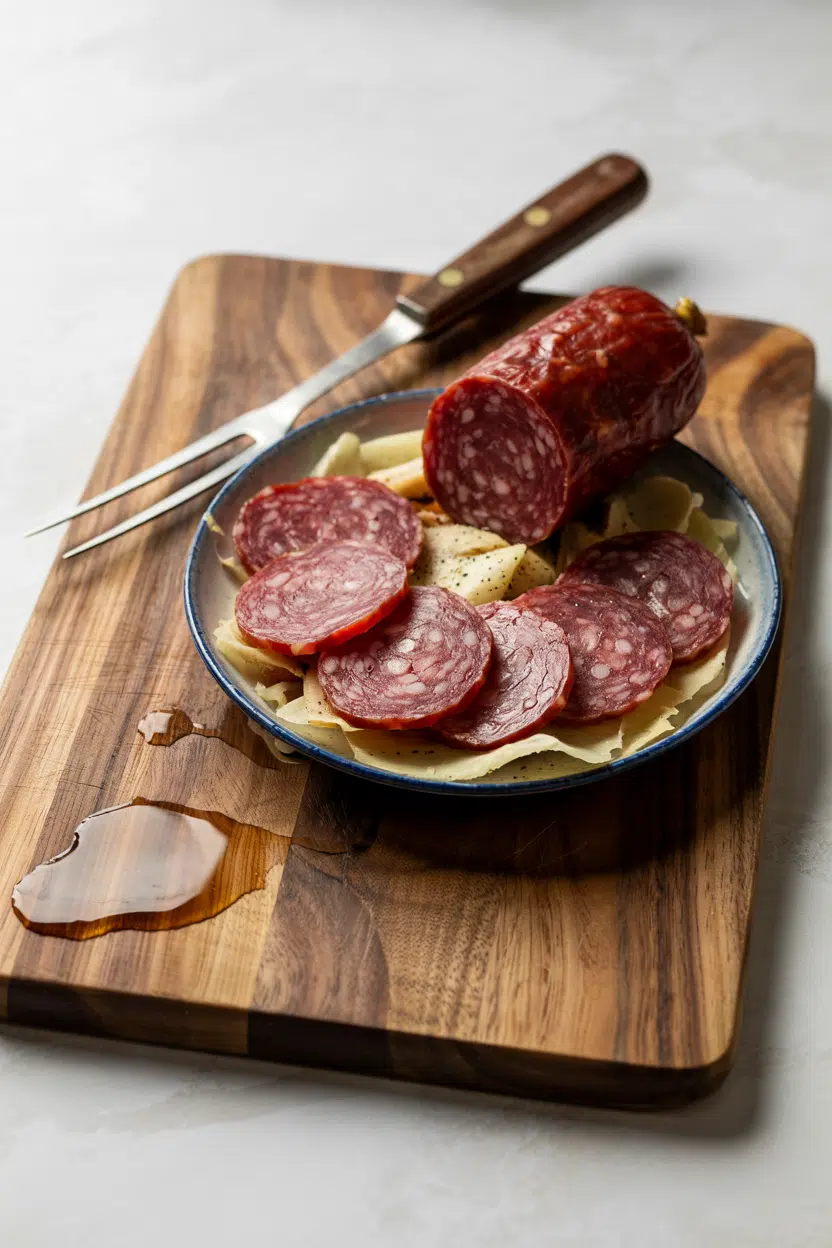
Salami's flavor is layered - deeply savory from cured meat, salty up front, and backed by a fermented tang that gives it more complexity than a fresh sausage. Think of it as a concentrated, spiced version of cured ham, somewhere between prosciutto in richness and pepperoni in seasoning intensity.
The fat marbling is central to how salami tastes. Those white flecks melt slightly at room temperature, delivering a creamy mouthfeel that balances the salt and acid.
Warming salami - in a pan or on a hot pizza - renders some of that fat and amplifies the savory, meaty notes.
Spice level shifts by variety. Soppressata can have real heat.
Genoa and Milano styles stay mild and let the fermented base shine through.
How to Use Salami
Salami needs no cooking. Thin slices served at room temperature are the default, and that's where it shows best on a charcuterie board alongside hard cheeses like Parmigiano-Reggiano or aged cheddar, soft cheeses like fontina, cornichons, and olives.
Fresh fruit - figs or melon - cuts the salt cleanly.
That said, heat unlocks a different side of it. Brief pan-frying renders the fat and crisps the edges, making it a strong addition to salads, tacos, or scrambled eggs.
On pizza, it curls and browns at the edges in a way pre-cooked toppings can't match.
| Method | Best For | Tip |
|---|---|---|
| 🥗 Raw/Sliced | Charcuterie, sandwiches, Italian hero, paninis | Slice thin; serve at room temperature for best texture |
| 🍳 Pan-Fried | Salad topper, taco filling, breakfast scrambles | Medium heat, no oil needed - the fat renders fast |
| 🍕 Baked | Pizza, flatbreads, focaccia, savory quick breads | Add in the last few minutes to prevent over-crisping |
| 🍲 Simmered | Pasta sauces, stews, braises | Dice small so fat melts into the sauce evenly |
In Italian-rooted cooking, diced salami simmered into a tomato sauce adds body and a salty-savory depth that builds over low heat. Folded into focaccia dough before baking, it studds the crumb with pockets of spiced fat.
How to Buy and Store Salami
Whole dry-cured sticks are easy to evaluate at the counter. Look for tight, unbroken casings without any bloating. A white or slightly gray exterior mold is normal and expected - it's part of the curing process. Cut slices should show distinct white fat flecks against deep red meat. Avoid anything with a sticky surface, liquid pooling in the packaging, or an ammonia-like smell.
Storage depends on whether the salami is whole or sliced. Whole sticks do best wrapped in butcher paper or breathable wrap - not plastic - so the casing can continue to regulate moisture.
Pre-sliced and vacuum-sealed packages go straight into the fridge and should be used within a few days of opening. For detailed timelines, check our salami freshness guide guide.
Where to Start with Salami
If you're new to this category, Genoa salami is the least intimidating entry point - mild, widely available, and works well on sandwiches or boards without overpowering other ingredients. From there, try soppressata for more heat and texture.
If you can't find salami, prosciutto replacements or pepperoni replacements can fill adjacent roles depending on whether you need a raw-cured slice or a pizza topping. And if you want to swap salami out of a recipe entirely, the salami swaps guide covers the closest matches by use case.
Frequently Asked Questions
Dry-cured salami is neither cooked nor truly raw - fermentation and drying preserve it without heat. The USDA considers fully dried salami safe to eat without cooking, though salami cotto is a cooked exception.
An opened whole stick keeps about 2-3 weeks refrigerated. Sliced salami drops to 3-7 days once the package is open and the cut surface is exposed to air.
Pepperoni is an American-style salami made with pork and beef, heavily spiced with cayenne and paprika. Traditional Italian salami uses more varied seasoning and relies more on fermentation tang than heat for its flavor.
Yes, the white mold on the casing of dry-cured salami is safe and intentional - it's typically Penicillium nalgiovense, applied to regulate drying. Peel or wipe it off before eating if you prefer; it's not harmful either way.
Whole, uncut dry-cured salami can sit at cool room temperature short-term, but refrigeration is safer and extends shelf life significantly. Once cut or sliced, refrigeration is required.