
Raclette cheese earns its place at the table not through cold flavor alone but through what happens the moment heat touches it - a slow, creamy melt that pools and browns at the edges in a way no other cheese quite replicates.

That behavior is the reason dishes alongside raclette have stayed unchanged for centuries: the cheese does something structural, not just flavorful.
If you've browsed alternatives to emmental cheese and found yourself circling back to raclette, that's because the melt profile here is genuinely different.
Raclette is a semi-hard, washed-rind cow's milk cheese from the Swiss and French Alps, built for melting. It tastes buttery, nutty, and mildly tangy - closer to mild Gruyère than anything sharp - and forms a creamy, lightly browned melt that is central to traditional Alpine service.
What Is raclette cheese?
Raclette originates from the Alpine regions of Switzerland and the Savoie in France, where mountain dairy traditions shaped an entire category of high-fat, melt-ready cheeses.
Remember it later
Planning to try this recipe soon? Save it for a quick find later!
The name itself comes from the French verb racler - to scrape - which describes the traditional method of heating a half-wheel near an open flame and scraping the softened surface directly onto food.
It falls into the category of washed-rind, semi-hard cow's milk cheeses, though the rind washing is typically mild rather than aggressive, which keeps the aroma at moderate rather than full-on pungent.
You'll also see it labeled as raclette de Savoie, fromage à raclette, or simply raclette cheese in retail packaging.
Wheels typically run 6-8 kg and are sold in wedges or sliced portions for home use.
Unlike swiss cheese stand-ins that mimic the style, authentic raclette - particularly AOC-certified Swiss raclette - has specific production controls tied to Alpine milk quality.
- 🏔️ Swiss raclette - the original, often with a more pronounced cellar aroma and slightly firmer paste
- 🇫🇷 Raclette de Savoie - French Alpine version, marginally creamier and milder in rind character
- 🏪 Industrial raclette - widely available, consistent melt behavior, milder overall flavor
What Does raclette cheese Taste Like?
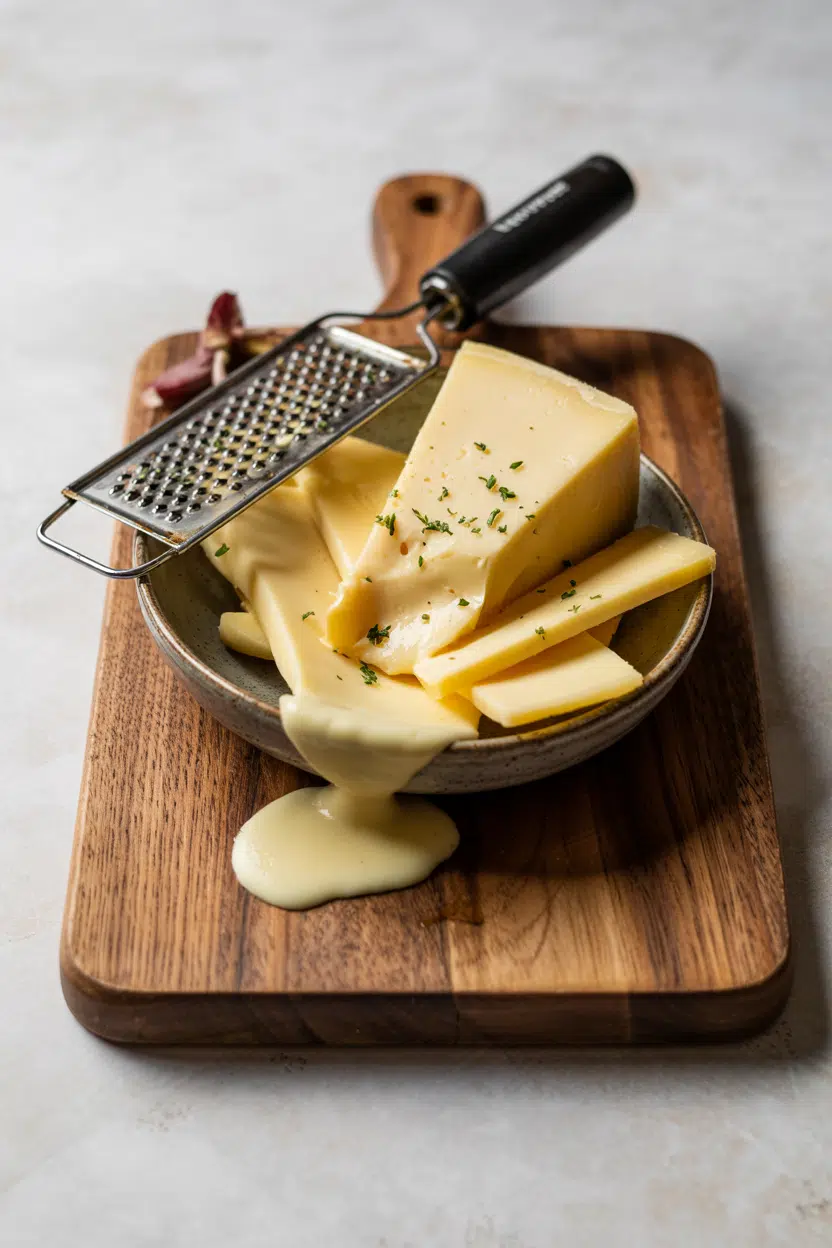
Cold raclette tastes buttery and nutty, with a mild tang that sits somewhere between young Gruyère and fresh Emmental - though creamier than either when sliced thin.
There's a quiet umami depth that becomes more obvious when the cheese warms.
For a closer look at how the benchmark compares, emmental cheese's flavor and uses shows where the two diverge in practice.
Heat changes the profile noticeably. Melted raclette softens its tang, pushes the buttery notes forward, and develops a faint toasty quality at the browned edge - that edge is where most of the flavor payoff lives.
How to Use raclette cheese
Raclette's primary role is melting, and the traditional service method remains the most effective way to showcase it.
A tabletop raclette grill - or a salamander broiler in a restaurant - heats the cheese in small individual pans (coupelles) until it bubbles and browns, then you tip it directly over boiled new potatoes.
Beyond traditional service, raclette works well wherever you need a reliable, creamy melt with browning character.
It holds together under a broiler without breaking or turning greasy, which makes it a good fit for gratins, open-face sandwiches, and burgers.
Swiss and French Alpine cooking lean on it heavily in potato bakes and vegetable gratins, and it layers well into macaroni-style pasta dishes where stretch and creaminess matter.
If you can't source it, understanding swapping out raclette cheese helps narrow down the closest alternative for each method.
| Method | Best For | Tip |
|---|---|---|
| 🔥 Raclette Grill | Traditional service over potatoes and cornichons | Use individual coupelles; don't let it sit once melted |
| 🍳 Broiled/Salamander | Burgers, open-face toasts, gratins | Position close to the element for quick browning without drying |
| 🫕 Low Oven | Potato bakes, pasta gratins | Keep oven under 180°C/355°F to melt evenly without separating |
| 🥗 Cold/Sliced | Sandwiches, paninis, cheese boards | Slice thin - the paste compresses when pressed on a panini grill |
Cornichons, pickled onions, and cured meats like prosciutto or air-dried ham are the classic flavor counterpoints - their acidity cuts through the cheese's richness.
Dry, acidic white wine (think Chasselas or Fendant from Valais) is the traditional pairing, though a light lager works equally well.
How to Buy and Store raclette cheese
At the counter, look for a wedge with a smooth, slightly oily natural rind and paste that ranges from pale cream to deep yellow. A thin, faintly tacky rind and small even holes in the paste are both normal.
Walk away from wedges with deep cracks, excessive dryness, or sour sticky patches on the cut face.
Wrap it in cheese paper or waxed paper and keep it in the fridge's cheese drawer or vegetable crisper where humidity stays higher. For a full breakdown of timelines and signs of spoilage, raclette cheese's shelf life covers the detail.
Vacuum-sealed, unopened wheels keep considerably longer - always check the producer's date rather than guessing.
Start Here for Raclette
Raclette rewards specificity.
If you're new to it, buy a small wedge of Swiss raclette (not the pre-sliced industrial variety) and melt it under a home broiler over halved boiled potatoes - that single test run shows you exactly what the cheese does.
If you want to compare flavor relatives, the taste of gruyere cheese and gruyere cheese swaps that work are useful benchmarks.
Raclette is less sharp, more yielding, and built entirely around the melt.
Frequently Asked Questions
No. Fondue blends cheese with wine in a communal pot for dipping. Raclette is melted in individual portions - traditionally by scraping a heated wheel - and served directly over food rather than used as a dipping medium.
Yes, and it works well at low to moderate heat. Keep the oven under 180°C (355°F) to melt evenly without the fat separating. Higher temperatures can cause the cheese to break and turn greasy rather than creamy.
Moderately salty - noticeably so, but not briny like feta. The salt level is part of why it pairs so well with unseasoned boiled potatoes, which absorb the cheese's seasoning during service.
Dry, high-acid white wines are the traditional match - Chasselas (Fendant) from Switzerland's Valais region is the classic choice. Dry Alsatian Pinot Blanc or a crisp Savoie white also work well without overwhelming the cheese.
Not fully, though aging reduces lactose significantly. Most people with mild lactose sensitivity tolerate raclette without issue, but those with high sensitivity or a diagnosed intolerance should treat it as a lactose-containing food.



