
Most people who pass choy sum at the market assume it's just another bok choy - smaller maybe, a bit leafier, roughly interchangeable with whatever other brassica is on the shelf.

That assumption costs them one of the most genuinely tender greens in Chinese cooking, one built specifically for speed, heat, and a faint floral note that no other leafy green quite replicates.
Unlike napa cabbage stand-ins that need bulk and braise time, choy sum is done in under two minutes and brings its own character to the plate.
Choy sum is a mild, lightly floral Chinese leafy green with edible yellow flower buds, tender leaves, and crisp pale stems. It cooks in under two minutes, suits stir-fries, blanching, and soups, and stays fresh for up to a week refrigerated.
What Is choy sum?
Choy sum - also called Chinese flowering cabbage or cai xin - originates from the Guangdong region of southern China, where it remains a staple of Cantonese home cooking.
Remember it later
Planning to try this recipe soon? Save it for a quick find later!
The name translates roughly to "vegetable heart," pointing to the tender inner stems and young flower shoots that make it prized.
Botanically it belongs to Brassica chinensis var. parachinensis, putting it in the same family as bok choy and gai lan, however its structure sets it apart clearly.
Each bunch has slender pale-green stems, soft broad leaves, and small edible yellow flower buds - the flowers are the telling identifier at market.
Those buds should be compact and mostly closed; fully opened blooms signal the plant has bolted and the stems will be tougher and more bitter.
You'll find it sold under several names depending on the region and retailer:
- 🌼 Cai xin / choi sum - Mandarin and Cantonese romanizations of the same plant
- Chinese flowering cabbage - the common English supermarket label
- Yu choy - a closely related variety, sometimes used interchangeably at market, though yu choy stems tend to be slightly thinner
If choy sum isn't available, a guide to choy sum stand-ins covers what holds up in similar dishes.
What Does choy sum Taste Like?
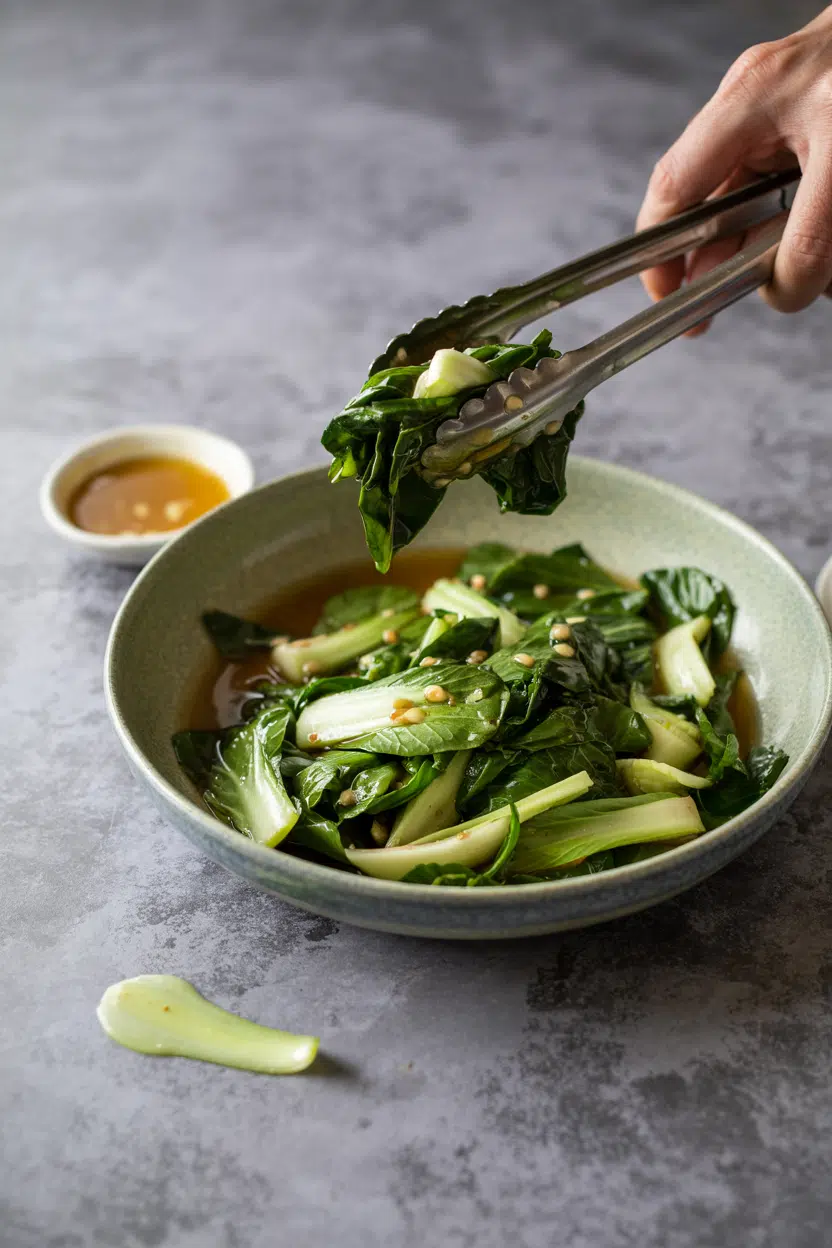
Choy sum sits at the mild end of the brassica spectrum.
The leaves deliver a clean, lightly bitter green flavor similar to spinach but with more structure, while the stems add a faint sweetness and a subtle mustardy edge - not sharp, more like a whisper.
Compared to bok choy, choy sum is noticeably more delicate - less watery in the stem, with a floral quality bok choy lacks entirely.
Gai lan is the earthier, slightly more bitter cousin; choy sum is softer in every respect.
Heat changes the profile quickly: brief cooking mellows the bitterness and brings forward the floral note, while overcooking collapses the stems and flattens the flavor entirely.
How to Use choy sum
Choy sum is built for high-heat, short-cook methods. The classic Cantonese preparation is a garlic stir-fry: a screaming-hot wok, a splash of light soy, thirty seconds of tossing, done.
The stems stay crisp, the leaves wilt just enough, and the garlic does most of the aromatic heavy lifting.
Blanching is equally common in Cantonese restaurants. Drop the whole bunch into salted boiling water for sixty to ninety seconds, drain, then dress with oyster sauce and sesame oil at the table.
If you ever need to swap that sauce, a guide to swapping out oyster sauce covers what keeps the dish working.
| Method | Best For | Tip |
|---|---|---|
| 🥢 Stir-fry | Weeknight sides, garlic dishes | Use the highest heat available; keep it moving |
| 💧 Blanching | Restaurant-style plated greens | Ice bath stops cooking and holds the color |
| 🍜 Soup | Noodle broths, hot pot | Add in the last 60 seconds only |
| ♨️ Steaming | Sides alongside fish or braised pork | Steam over already-boiling water, lid on tight |
| 🥗 Raw (young shoots) | Light salads with vinaigrette | Use only the smallest, most tender inner leaves |
Beyond standalone sides, chopped choy sum works well as a dumpling filling - the moisture releases during steaming rather than making the wrapper soggy, unlike denser cabbages. It also fits neatly into noodle soups alongside pork or tofu.
Dense cream or dairy sauces overwhelm its delicate character, so keep the pairings light and lean.
How to Buy and Store choy sum
At the market, reach for bunches with bright, uniformly green leaves and firm pale stems. Compact yellow buds are a good sign - they indicate the plant hasn't yet bolted.
Skip any bunch with limp leaves, brown stem edges, or thick woody bases; those signal overmaturity and a tougher, more bitter result.
Proper storage matters for a green this delicate, and keeping choy sum fresh comes down to moisture control - wrap unwashed bunches in a damp paper towel, seal loosely in a perforated plastic bag, and refrigerate in the crisper drawer.
- Shelf life - 3 to 7 days refrigerated; use closer to 3 days for peak texture and floral aroma
- Don't wash before storing - excess moisture accelerates leaf breakdown significantly
- Signs of decline - yellowing leaves, softened stems, or a sulfurous smell mean it's past its window, much the same way [broccoli spoilage signs](https://forkliftkitchen.com/broccoli-shelf-life/) work in the same family
Start With the Stir-Fry
If this is your first time cooking choy sum, the garlic stir-fry is the right entry point.
It takes under five minutes, uses pantry staples, and shows you exactly how quickly this green transforms under heat.
Once you've nailed timing - and you'll know because the stems go bright and crisp without going limp - every other method becomes easier to calibrate.
For comparison, understanding what makes bok choy distinct helps clarify why choy sum earns its own place rather than functioning as a simple swap.
The alternatives to bok choy guide is also useful if you're building a recipe around Cantonese greens and need flexibility.
Frequently Asked Questions
Yes - cai xin is the Mandarin romanization of the same plant choy sum names in Cantonese. Both refer to Chinese flowering cabbage. Some regional markets label them differently, however the vegetable in the bundle is identical.
Choy sum is more delicate and has a faint floral note that bok choy lacks. Bok choy has thicker, more watery stems and a cleaner, blander green flavor with no mustardy edge.
Young shoots and inner leaves work raw in salads after thorough washing. Larger stems are edible raw but can be mildly tough and slightly more bitter; brief blanching makes them easier to digest.
Properly stored, choy sum lasts 3 to 7 days. Wrap it unwashed in a damp paper towel and keep it in the crisper; floral aroma fades first, so use it early for the best result.
It's most common in Cantonese stir-fries, blanched as a plated side with oyster sauce, and added to noodle soups in the final minute. It also appears chopped in dumpling fillings and lightly raw in salads.



