Pecans do something in cooking that few other nuts manage: they melt slightly into whatever surrounds them, lending fat and sweetness without announcing themselves the way the taste of hazelnut does or demanding the neutral backdrop that macadamia nuts in cooking often require.

That quiet richness is why they anchor pecan pie, hold praline together, and show up crusted on fish without overwhelming it.
Pecans are oil-rich tree nuts native to North America with a buttery, sweetly nutty flavor and moderate intensity. Toasting deepens their caramel notes. Use them in pies, pralines, salads, and crusts. Shelled pecans keep 3-6 months refrigerated or over a year frozen.
What Is Pecans?
Carya illinoinensis - the pecan tree - is native to the river valleys of the southeastern United States and northeastern Mexico, making the pecan North America's only commercially significant native tree nut. Kernels are two-lobed, oblong, and covered in a papery brown skin that carries mild tannins.
Remember it later
Planning to try this recipe soon? Save it for a quick find later!
Most pecans sold in the US come from Georgia, Texas, and New Mexico. Varieties range from Desirable and Stuart (large, easy-to-crack shells common in retail) to Elliot and Schley (smaller, with more concentrated oil).
Shell-on nuts are often labeled by variety at specialty stores; shelled nuts rarely are.
The name traces back to an Algonquian word meaning "nut that requires a stone to crack." Alternate names include American pecan and pecan nut; pican is a regional misspelling, not a distinct variety.
- 🌱 Wild vs. cultivated - Wild trees still grow along river floodplains; commercial orchards produce the uniform halves you find at grocery stores.
- 🥜 Size grading - Halves are graded by count per pound; fewer per pound means larger nuts with more intact meat.
- 🛢️ Oil content - Pecans contain roughly 72% fat by weight, among the highest of any tree nut, which drives both their richness and their rancidity risk.
What Does Pecans Taste Like?
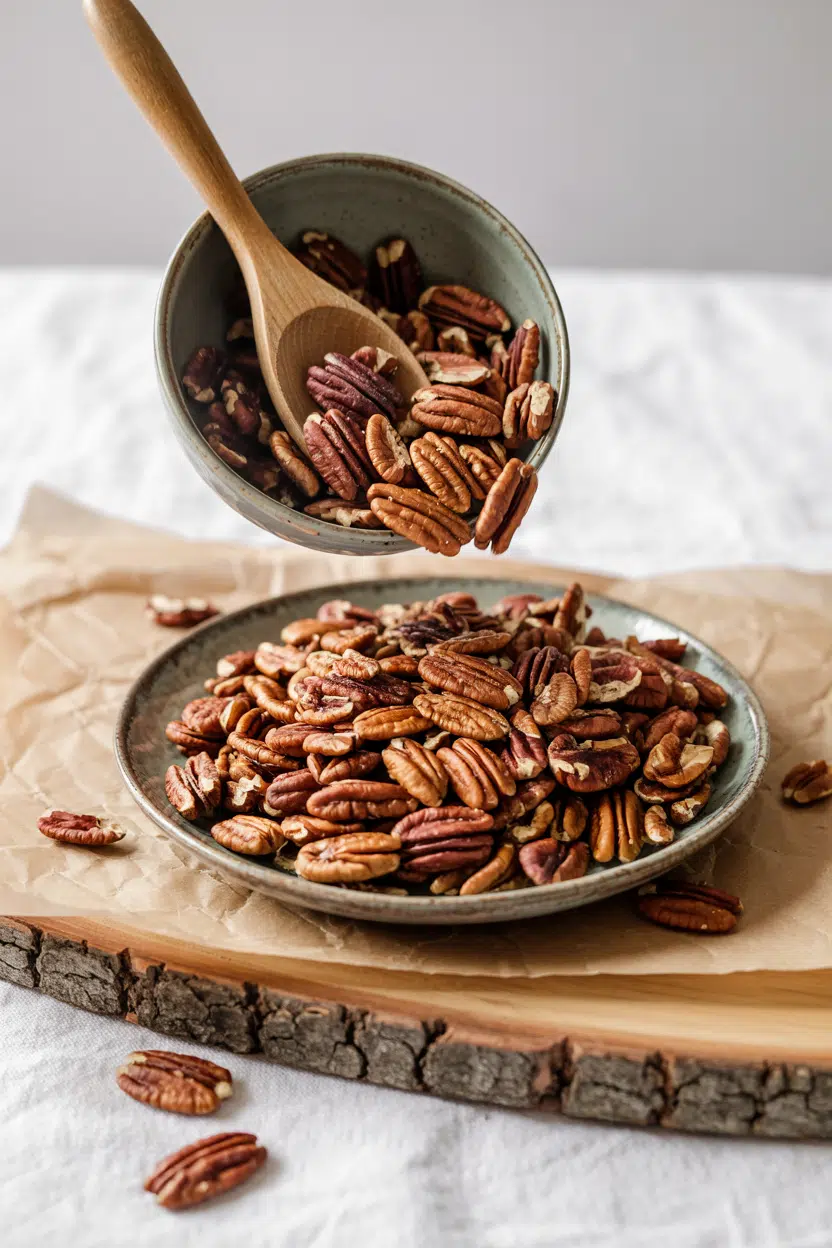
Raw pecans open with a clean, buttery sweetness and settle into a gently nutty finish with a faint bitterness from the skin's tannins.
That bitterness is mild - nothing like the sharp astringency in walnuts - which is exactly why pecans read as sweeter and more approachable to most palates.
Heat changes them considerably. Dry-toasting pulls forward caramel and vanilla-adjacent notes while softening the skin bitterness.
That's the version that makes pecan pie smell like it does straight from the oven.
Compared to almonds - which lean drier and more neutral, as covered in what makes almonds distinct - pecans have a noticeably higher perceived sweetness and far more fat-forward character.
How to Use Pecans
Pecans work across a wider range of applications than most cooks use them for.
Southern United States cooking claims them most famously - pecan pie and pecan praline are the canonical examples - but their fat content and moderate flavor make them useful far outside dessert territory.
In savory cooking, ground or finely chopped pecans coat chicken and fish fillets, forming a crust that browns well in a hot pan. They fold into quick breads and muffins without sinking when cut into small pieces.
Blended with a little oil, they produce a pecan butter that works in sauces, dressings, and as a spread.
| Method | Best For | Tip |
|---|---|---|
| 🥗 Raw | Salads, cheese boards, trail mix, batters | Chop small so they distribute evenly in batters |
| 🔥 Dry-toasted | Granola, pie filling, snacking, salad toppers | Watch closely - they burn fast after minute 8 |
| 🍞 Baked | Pecan pie, muffins, cookies, crusts | Whole halves on top; chopped into batter |
| 🍯 Candied/simmered | Pralines, glazed nuts, dessert garnishes | Use a candy thermometer - syrup stage matters |
| ⚙️ Ground | Nut meal for crusts, pecan butter, sauces | Pulse in short bursts to avoid turning into paste |
Pecans pair naturally with maple syrup, brown sugar, and bourbon, which is why they anchor so many fall and winter recipes. Dark chocolate, sharp cheddar, sweet potatoes, and fresh pear all work well alongside them.
Rosemary and thyme can steer pecans toward savory territory when used in spiced roasted nut blends.
If a recipe calls for pecans and you don't have them, pecans swaps that work covers which alternatives hold up in pies, crusts, and candied preparations.
How to Buy and Store Pecans
Smell before you buy. Rancid pecans have a sharp, paint-like or musty odor that no amount of toasting will fix. With shelled halves, look for uniform color with no dark interior spots; a grayish tinge inside signals oxidation.
For shelled pecans, vacuum-sealed or nitrogen-flushed packaging extends freshness significantly. Once opened, transfer to an airtight container and refrigerate.
For in-shell pecans, intact shells without cracks or mold at the seams are what you want - heavy nuts for their size signal full, oil-rich kernels.
Full detail on how long pecans keeps by storage method is worth checking before buying in bulk.
The short version: shelled nuts last 3-6 months refrigerated and over a year frozen; in-shell nuts hold 3-6 months in a cool, dry pantry.
Start Here With Pecans
If you haven't cooked with pecans before, dry-toast a small handful first - no oil, no sugar, just a dry skillet over medium heat.
That single step shows you exactly what they become with heat and sets up every recipe after it.
From there, try them chopped into a salad with sharp cheddar and a maple vinaigrette. That combination hits every pairing note at once and takes about three minutes.
Frequently Asked Questions
No. Both belong to the Juglandaceae family, but pecans are a distinct species - Carya illinoinensis - native to North America. Walnuts come from the Juglans genus and have a sharper, more tannic flavor than pecans.
Yes, raw pecans are safe to eat and commonly used in salads, trail mix, and batters. The flavor is milder than toasted - buttery with a faint green note - and the skin's tannins are slightly more noticeable.
Pecans are sweeter and less astringent, so they blend into batters without adding bitterness. Walnuts hold their flavor more aggressively, which can compete with delicate baked goods - pecans rarely do.
Faster than most nuts, because of their high fat content. Shelled pecans left at room temperature can turn rancid within weeks. Refrigerating or freezing them extends shelf life dramatically.
Not significantly. Pecans are rich in monounsaturated fat - mainly oleic acid - not omega-3s. Walnuts are a far better source of plant-based omega-3 (ALA) among tree nuts.