
Most people assume almonds are a simple snack ingredient - something you grab from a bowl and move on.

What they miss is how dramatically the nut changes depending on what you do to it: raw almonds are firm and lightly sweet, while roasting them unlocks a deeper, almost buttery nuttiness that behaves differently in cooking.
If you've ever wondered why a recipe insists on blanched rather than raw, or why marzipan swaps that work matter so much when almond paste is the base flavor, the answer starts with understanding what almonds actually are and how their form shapes their taste.
Almonds are edible tree nut seeds with a mildly sweet, buttery flavor that intensifies when roasted. Sold raw, roasted, blanched, or ground, they work across sweet and savory cooking. Store them cold to prevent rancidity and use within 6-12 months once opened.
What Is Almonds?
Almonds are the edible seeds of Prunus dulcis, a flowering tree native to the Levant and Mediterranean region.
Remember it later
Planning to try this recipe soon? Save it for a quick find later!
Despite being called a nut in every kitchen context, the almond is technically a drupe seed - the kernel inside a stone fruit, like a peach pit you can eat.
Most almonds in commercial supply are sweet almonds, the variety grown across California, Spain, and Italy for food use.
Bitter almonds (Prunus dulcis var. amara) are a separate subtype containing amygdalin, a compound that converts to hydrogen cyanide in raw form, making them unsafe to eat unprocessed - their flavor shows up instead in extracts and liqueurs.
At market, sweet almonds appear in several forms:
- 🌰 Raw almonds - whole, unprocessed kernels with the brown testa (skin) intact
- Blanched almonds - skin removed by brief hot-water treatment, revealing a smooth white kernel
- Roasted almonds - dry-roasted or oil-roasted, with intensified flavor
- Almond flour / almond meal - ground from blanched or whole almonds respectively; not interchangeable in fine pastry work
- Almond butter - ground to a paste, used like peanut butter in spreads and sauces
California produces roughly 80% of the world's commercial almond supply, so most almonds on U.S. shelves are California almonds, typically the Nonpareil variety.
What Does Almonds Taste Like?
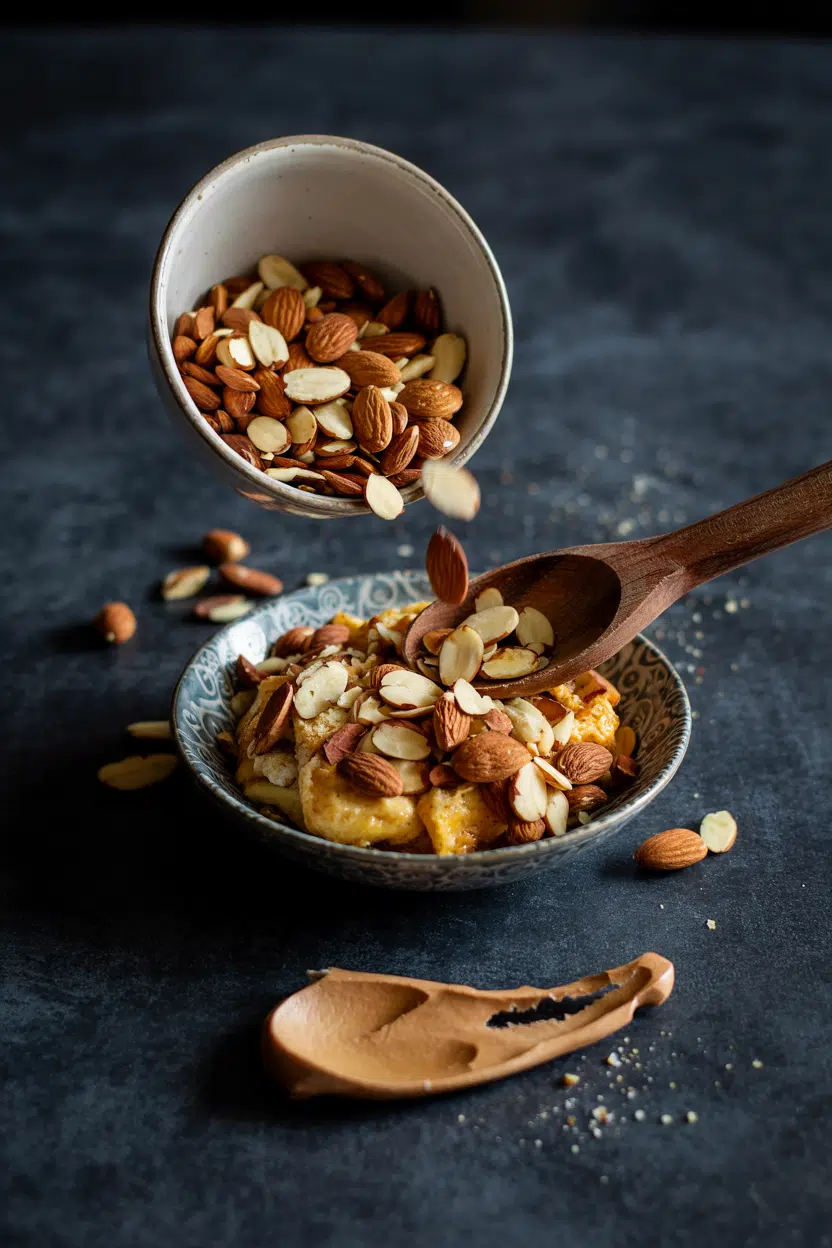
Raw almonds have a mild, buttery sweetness with a faint floral note underneath - nothing aggressive, nothing sharp. That restraint is exactly what makes them so useful across different cuisines.
Roasting changes everything. Heat drives off moisture and triggers browning reactions that push the flavor toward a deeper, toasty nuttiness with more pronounced richness.
Ground into almond flour, that same kernel becomes slightly creamy and almost neutral, absorbing surrounding flavors rather than competing.
Compared to cashews, almonds are firmer with a more pronounced toasty edge - when blended into milk, though, the creaminess is similar. Bitter almonds carry a sharp, almost medicinal marzipan note that sweet almonds only hint at faintly.
How to Use Almonds
Almonds shift roles depending on their form, and understanding that is what separates average cooking from precise cooking. Whole roasted almonds add crunch to grain bowls and green salads; slivered and toasted, they finish roasted vegetables cleanly.
Almond-crusted fish - trout or tilapia with a coarse almond coating - is a simple technique that adds real texture contrast.
In baking, almond flour is the backbone of macarons, frangipane tarts, and most gluten-free cakes. Note that keeping almond flour fresh matters more than with whole nuts - ground almonds go rancid faster because of increased surface area exposure.
Marzipan and almond paste both rely on blanched almonds pureed with sugar, though they differ in ratio and texture.
For beverages and dairy-free cooking, soaked almonds blended and strained produce almond milk with a clean, slightly sweet character.
Almond butter works anywhere you'd consider alternatives to butter in sauces or spreads - it adds body and a mild nuttiness without overpowering.
| Method | Best For | Tip |
|---|---|---|
| 🥗 Raw | Snacking, salad toppings, soaking for milk | Soak overnight to soften skins before blending |
| 🔥 Dry-Roasted | Garnishing, grain bowls, snacking | Watch closely - almonds go from golden to burnt fast |
| 🧁 Ground (Flour) | Macarons, frangipane, gluten-free cakes | Use blanched for fine pastry; meal for denser bakes |
| 🍯 Caramelized | Praline, brittle, ice cream mix-ins | Use dry sugar method for even coating |
| 🥛 Soaked & Blended | Almond milk, almond cream | Strain through a nut bag for the smoothest result |
Almonds pair particularly well with honey, dark chocolate, and citrus - orange and almond is a classic French patisserie combination. In Mediterranean and Middle Eastern cooking, they appear alongside dried apricot and fig.
Indian cuisine uses ground almonds to thicken and enrich korma-style sauces.
How to Buy and Store Almonds
Good almonds look plump, with a uniform tan color and firm texture. Reject any kernels that are shriveled, oily to the touch, or show dark spotting - those are signs of rancidity or poor storage, and the off-flavor will carry through into whatever you cook.
Once opened, almonds need protection from heat, light, and air. Refrigeration is the practical choice for most kitchens - a sealed container keeps shelled almonds good for 6-12 months.
Freezing extends that window to 12-24 months without quality loss, and the details of storing almonds correctly make a real difference if you buy in bulk.
At room temperature, opened almonds hold for about 2-3 months if kept away from heat sources. Don't store them near the stove.
Where to Start With Almonds
Almonds reward anyone willing to work with more than one form.
If you're new to cooking with them, start with dry-roasting - a dry skillet over medium heat for 4-5 minutes gives you an immediately better product than anything from a pre-roasted bag.
From there, try swapping out almonds when a recipe calls for a different nut - almonds hold up in most contexts where cashews or hazelnuts are used.
Once you're comfortable with whole and sliced forms, moving into almond flour or almond butter opens up a much wider range of dishes.
Frequently Asked Questions
Technically, almonds are seeds - the kernel of a stone fruit related to peaches and plums. In cooking and food labeling, however, they're classified as tree nuts, and that distinction matters most for allergy purposes.
Yes - raw sweet almonds are safe to eat straight from the bag. Most commercially sold "raw" almonds in the U.S. are actually pasteurized, typically via steam treatment, though the process doesn't meaningfully change flavor.
Bitter almonds have an intense, sharp marzipan-like flavor - much stronger than sweet almonds and with a medicinal edge. That character comes from amygdalin, the compound that also makes raw bitter almonds unsafe to consume directly.
No. Almond flour is made from blanched (skinless) almonds and has a finer, lighter texture suited to macarons and frangipane. Almond meal is ground from whole almonds with skins, producing a coarser, darker result better for dense cakes and crusts.
Shelled almonds kept in an airtight container in the refrigerator stay fresh for 6-12 months. Rancidity - detected by a bitter, paint-like smell - is the main spoilage sign to check for before using older stock.



