
You spot it at the cheese counter - a pale-yellow wedge dotted with large, round holes - and wonder if it's just another Swiss stand-in.

Jarlsberg is worth a closer look, especially if you've been reaching for replacements for gruyere cheese or havarti cheese swaps that work and haven't found the right fit.
This Norwegian original has a specific character - nutty, buttery, genuinely mild - that earns its place on a board and in a pan.
Jarlsberg is a semi-soft Norwegian cow's-milk cheese with large round eyes, a smooth texture, and a mild nutty-sweet flavor. It melts cleanly, slices well cold, and works across sandwiches, gratins, and cheese boards without overpowering other ingredients.
What Is Jarlsberg Cheese?
Jarlsberg is a Swiss-type cow's-milk cheese produced in Norway, first made commercially in the Telemark region near the historic Jarlsberg estate.
Remember it later
Planning to try this recipe soon? Save it for a quick find later!
It belongs to the semi-soft category - firmer than fresh mozzarella, softer than aged cheddar - and is sometimes labeled Jarlsbergost in Norwegian.
Its most recognizable feature is the pattern of large, evenly spaced round holes, called eyes.
These form during fermentation when Propionibacterium freudenreichii bacteria release carbon dioxide gas, the same mechanism behind comte cheese swaps that work when a hole-forming cheese is needed in a recipe.
Standard Jarlsberg is aged around three months and has that pale-yellow interior. A reserve or aged version exists, matured for around 12 months or more, and it develops a drier, firmer texture with slightly sharper flavor.
- 🧀 Standard (3 months) - mild, moist, and springy; the most common retail format
- 🧀 Aged Reserve (12+ months) - drier, more complex, with a firmer bite and less residual lactose
- 🧀 Baby Jarlsberg - smaller wheels, same recipe, often sold sliced in deli packs
What Does Jarlsberg Cheese Taste Like?
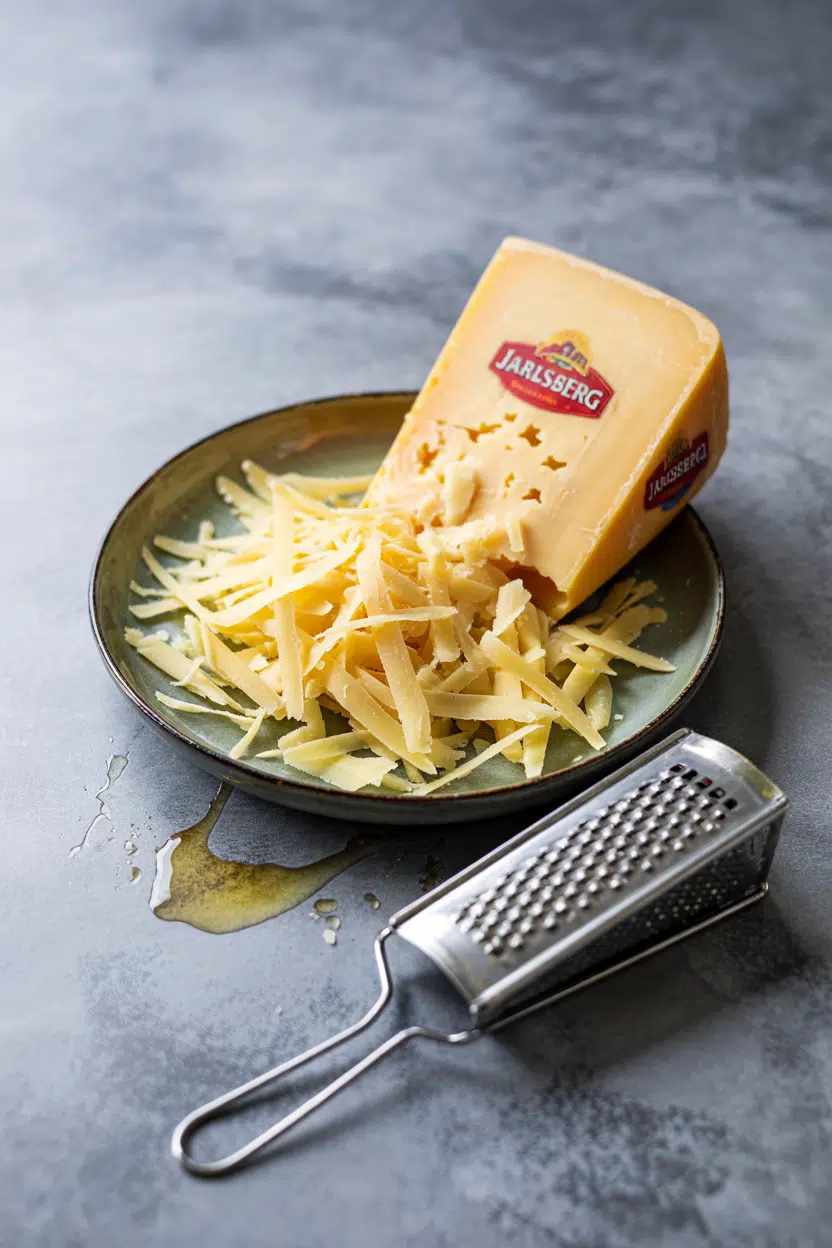
Jarlsberg lands firmly in mild territory. The dominant note is nutty and slightly sweet - closer to almond than hazelnut - with a clean, milky finish that doesn't linger aggressively.
Compared to a young Emmental, Jarlsberg is noticeably sweeter and less earthy. It lacks the sharpness of Swiss alpine styles, which makes it approachable but also means it won't assert itself in strongly spiced dishes.
Heat changes it meaningfully. Warmed or melted Jarlsberg turns creamy and glossy, and its sweetness becomes more pronounced - that's the quality that makes it so reliable in hot applications.
How to Use Jarlsberg Cheese
Jarlsberg performs across more contexts than most mild cheeses because its smooth melt and neutral sweetness don't clash with bold companions. Understanding using jarlsberg cheese for creaminess also helps when you want the same result from a different cheese.
Cold applications are straightforward. Sliced thin on a smørbrød - a Norwegian open-faced sandwich - with cured ham or smoked salmon is the traditional starting point.
On a cheese board, cubed Jarlsberg pairs especially well with apple slices, honey, and walnuts, which echo its almond-like notes rather than compete with them.
| Method | Best For | Tip |
|---|---|---|
| 🥗 Cold/Sliced | Sandwiches, smørbrød, cheese boards | Slice thin for smørbrød; cube thicker for boards |
| 🍳 Pan-Melted | Grilled cheese, burgers, quesadillas | Medium heat prevents oiliness; don't rush the melt |
| 🫕 Baked/Broiled | Gratins, casseroles, pasta bakes | Shred finely - it melts faster and more evenly |
| 🥚 Grated Into Sauces | Mac and cheese, omelettes, quiches | Add off heat to prevent graininess in cream sauces |
For baked dishes, a creamy potato gratin recipe is one of the cleaner showcases for Jarlsberg's melting behavior - its milky sweetness balances starchy, savory layers without adding sharpness.
For a different take on melting Swiss-style cheeses in cooked dishes, using emmental cheese for creaminess shows how the category behaves more broadly.
Avoid pairing Jarlsberg with very pungent blue cheeses on the same board; they'll drown its subtle profile completely.
How to Buy and Store Jarlsberg Cheese
At the counter, look for pale-yellow flesh with evenly spaced, round eyes and a clean smell. Dark spots, an excessively oily cut surface, or a sour odor are signs the piece is past its prime.
Younger standard Jarlsberg feels slightly springy when pressed; aged reserve is firmer and drier.
Wrap opened wedges in cheese paper or parchment, then place loosely inside a resealable bag in the coldest part of your refrigerator.
An opened wedge stored this way holds well for 2-3 weeks.
For more detail on timing and signs of spoilage, jarlsberg cheese's shelf life covers the specifics.
Whole unopened wheels keep significantly longer - several months refrigerated - because the rind acts as a barrier.
Where to Start With Jarlsberg
Buy a standard wedge, not the aged reserve, for your first trial. Cold, it proves itself quickly on a sandwich with ham and mustard.
Melted, try it in a simple grilled cheese before committing to a larger baked dish.
- First buy - standard wedge from the deli counter, not pre-sliced packs if possible
- First cold use - open-faced sandwich with rye bread, ham, and a smear of coarse mustard
- First hot use - grilled cheese on sourdough, medium-low heat, lid on to encourage even melting
Once you've seen how it behaves in both states, scaling up to gratins or cheese boards is straightforward. The role emmental cheese plays in similar recipes is useful context if you're deciding between the two.
Frequently Asked Questions
They're closely related. Jarlsberg uses the same hole-forming fermentation as Emmental and tastes similar, but it's noticeably sweeter and creamier than most Swiss-style cheeses. Think of it as a milder, more buttery version of young Emmental.
Yes - it melts cleanly and evenly without separating into greasy puddles, which makes it reliable in gratins, sauces, and grilled cheese. Shredding it cold before applying heat gives the most consistent results.
It contains low to moderate lactose depending on age. Aged reserve Jarlsberg has less residual lactose than the standard variety because aging breaks down more of the milk sugars. Those with moderate lactose sensitivity often tolerate aged versions better.
Plain Jarlsberg cheese contains no gluten ingredients. However, cross-contamination is possible at deli counters where bread is also sliced. Buying a sealed pre-packaged wedge reduces that risk.
An opened wedge wrapped properly in cheese paper lasts 2-3 weeks in the refrigerator. Plastic wrap shortens that window by trapping moisture against the cut face and accelerating surface mold.



