
Bite into a kalamata olive and you get three things at once: salt, fruit, and a faint winey bitterness that lingers at the back of the mouth.

Unlike the mild, almost neutral castelvetrano olive's flavor and uses, kalamatas lead with intensity.
They're not a background ingredient - they shape every dish they touch, and knowing how to use them well changes the way you approach Mediterranean cooking.
If you make tapenade regularly, it's also worth understanding olive tapenade spoilage signs so nothing goes to waste.
Kalamata olives are dark purple, almond-shaped table olives from Greece's Peloponnese region, cured in red wine vinegar or brine. They deliver a briny, fruity, tangy punch with a meaty texture - best used raw as a finishing ingredient, not cooked down.
What Is Kalamata Olives?
Kalamata olives come from a specific olive variety - the Kalamon - grown in the Peloponnese region of southern Greece, particularly around the city of Kalamata.
Remember it later
Planning to try this recipe soon? Save it for a quick find later!
They carry a Protected Designation of Origin (PDO), which means authentic Kalamata olives must be grown and processed in that region.
These are table olives, not pressing olives. The fruit is harvested ripe and dark, then cured in red wine vinegar or red wine brine - a process that gives them their distinctive tang.
You'll see them sold pitted or whole, sometimes packed in olive oil, sometimes in brine.
Shape sets them apart from other dark olives. Kalamatas are almond-shaped with a pointed tip, noticeably longer and more tapered than round canned black olives.
They're also sometimes called Kalamata Greek olives or, outside Greece, simply "kalamatas" - though "kalamatta" is a common misspelling.
- 🫒 Kalamon - the Greek varietal name for the same olive
- 🌍 PDO status - production is legally tied to the Peloponnese region
- 🍷 Red wine vinegar cure - what separates their flavor from brine-only olives
- 🫙 Packed formats - sold in brine, olive oil, or dry-salt packs
What Does Kalamata Olives Taste Like?
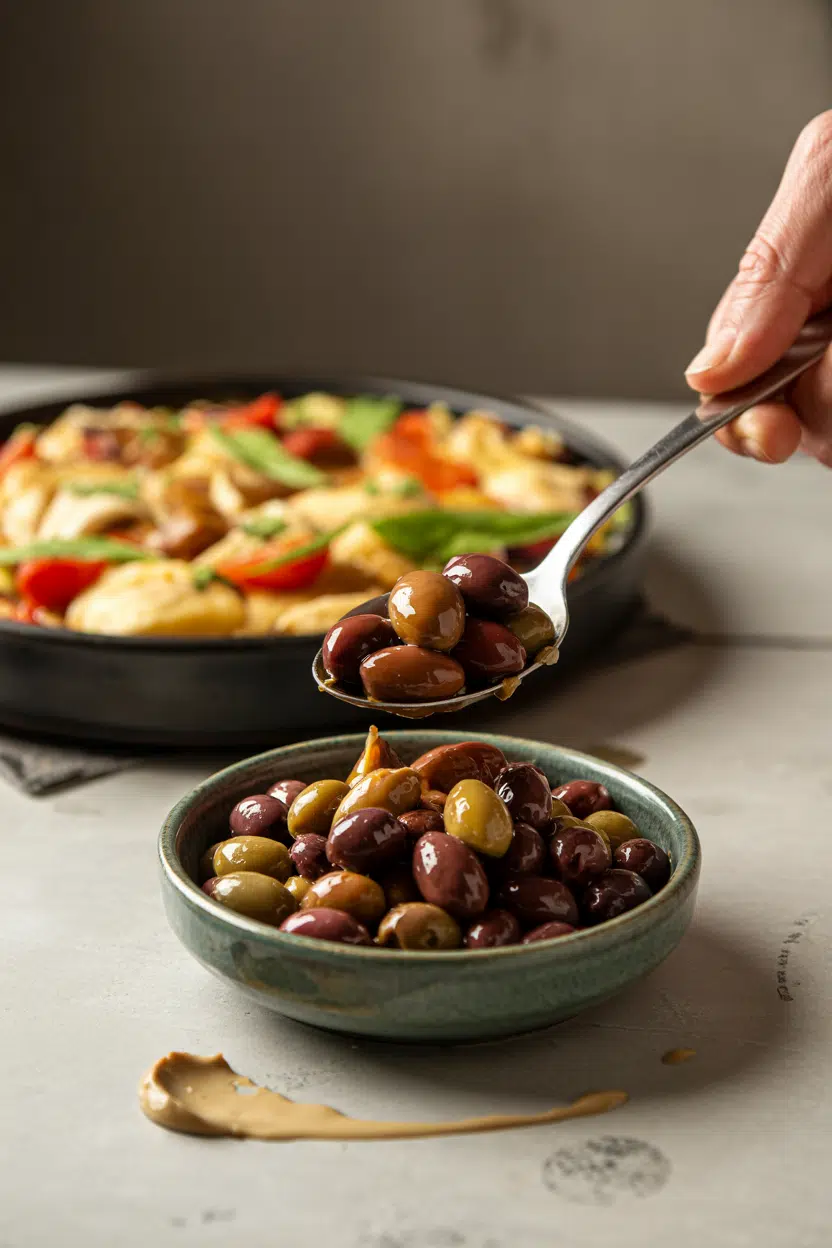
Kalamata olives taste nothing like the canned black olives found on pizza or in salad bars.
Those are processed with lye for uniform color and taste mild, almost flat. Kalamatas are fruit-forward - the ripe plum note hits first, then brine, then a tangy edge from the wine-vinegar cure.
The finish has a subtle almond-like bitterness - not harsh, more of a dry close that lingers.
Texture matters here, too: the flesh is meaty and firm, which means kalamatas hold their shape in salads and on boards rather than collapsing into the surrounding ingredients.
Heat softens that tang. Stirred into a warm tomato sauce, the sharpest edges round off while the briny-savory quality deepens.
Eaten straight from the jar at room temperature, the full fruit-forward intensity is most apparent.
How to Use Kalamata Olives
Kalamatas are a finishing ingredient first.
Adding them at the end of cooking, rather than simmering them down, preserves the fruit and tang that make them distinctive.
This is the approach used in pasta puttanesca - the olives go in during the last few minutes alongside capers, and the caper and its flavor works in tandem with kalamatas to build the sauce's signature sharpness.
They're a natural anchor on a mezze board, served whole alongside feta and cured meats.
For tapenade, pit and blend them with capers, anchovy, garlic, and olive oil - if you're skipping the fish, a replacements for anchovy guide covers the best umami swaps.
Chopped kalamatas scattered over grilled fish or roasted vegetables need no preparation beyond draining and roughly cutting.
| Method | Best For | Tip |
|---|---|---|
| 🥗 Raw / Whole | Greek salad, mezze boards, sandwiches | Drain and pat dry so they don't waterlog other ingredients |
| 🍳 Warmed in Sauce | Pasta puttanesca, tomato-based braises | Add in the final 2-3 minutes only |
| 🫙 Blended | Tapenade, hummus topping, labneh garnish | Pit fully before blending - stone fragments are sharp |
| 🔥 Roasted | Alongside vegetables, stuffed and baked as appetizers | Use oil-packed olives for roasting - they brown better |
Pairings that work consistently: feta and sheep's milk cheeses, tomato, cucumber, oregano, lemon, and grilled lamb. Red wine or dry rosé alongside a mezze spread is a pairing that holds up well.
Avoid sweet glazes - the brine tang clashes rather than complements.
How to Buy and Store Kalamata Olives
Look for olives that are uniformly dark purple to mahogany and visibly plump. Shriveled flesh or cloudy brine with surface mold are both signs to skip the jar - a quick check of olives spoilage signs covers what to watch for.
For best authenticity, choose jars labeled "Kalamon" or "Product of Greece."
Storage after opening is straightforward: keep olives submerged in their brine or olive oil in a sealed container in the refrigerator. Don't drain and store them dry - they'll oxidize and toughen within days.
The guide to storing kalamata olives correctly goes deeper on both opened and unopened timelines.
- 🛒 Unopened shelf life - months to 2 years depending on pack date and label
- ❄️ Opened, refrigerated in brine - peak quality for 1-2 months
- 🫙 Best container - glass jar with a tight lid, olives fully submerged
- 🧀 Paired storage tip - store away from strong-smelling items; brine absorbs odors
If you're also working with feta in the same dish, knowing feta spoilage signs keeps both components fresh through the week.
Where to Start with Kalamata Olives
Start with a Greek salad - no cooking required, and the olive's full character comes through undiluted. From there, pit and rough-chop them over hummus or labneh to see how they work as a garnish.
If the intensity feels like too much straight, look at alternatives to kalamata olives for milder options that still carry brine and body.
These olives are high in sodium, so portion accordingly if that's a concern. A small handful - six to eight olives - is enough to anchor most dishes without overwhelming them.
Frequently Asked Questions
Yes, but they're not purely salty - the wine-vinegar cure adds a distinct tang alongside the salt. Oil-packed versions tend to taste slightly less sharp than those stored in straight brine.
Canned black olives are typically lye-processed California olives with a mild, flat flavor. Kalamatas are naturally ripened, wine-vinegar cured, and noticeably more fruity, tangy, and complex.
Not necessarily. Rinsing reduces surface saltiness, which helps if they're going into a dish with other salty components like feta or anchovy. Eaten on their own or on a board, skip the rinse.
No - the pit is a hard stone, not edible. Always pit kalamatas before blending into tapenade or adding to dishes where someone might bite down unexpectedly.
Kept submerged in brine or olive oil in a sealed container in the fridge, they hold peak quality for 1-2 months. Olives left exposed to air deteriorate faster and may develop off-flavors within days.



