
You spot it on the shelf at an international grocery - a squat yellow jar with bold red lettering, contents invisible through the opaque packaging. Vegemite doesn't advertise itself the way most spreads do.
It's famously polarizing, yet Australians have been reaching for it at breakfast for over a century, and cooks worldwide are quietly folding it into broths and gravies as an umami boost hiding in plain sight.
Vegemite is a dark brown yeast extract paste from Australia with an intensely salty, umami-forward flavor. Spread thin on buttered toast, it's a breakfast staple. Used in small quantities, it deepens soups, stews, and gravies. Very high sodium - a little goes a long way.
What Is Vegemite?
Vegemite is an Australian yeast extract spread produced by Bega Cheese (formerly Kraft Foods) since 1922.
Remember it later
Planning to try this recipe soon? Save it for a quick find later!
It's made from the byproduct of beer brewing - spent brewer's yeast - which is processed, concentrated, and blended with salt, malt extract, and B vitamins to create a thick, dark-brown paste.
The product sits firmly in a category alongside Marmite, the British yeast spread it's most often compared to, and the milder Australian competitor Promite. Vegemite is not a Marmite copy - the formulation differs, producing a noticeably saltier, less sweet result with more pronounced bitterness.
It's sold exclusively in jars and is sometimes called simply "yeast spread" outside Australia. No meaningful varieties exist beyond a reduced-salt version and a cream cheese blend ("Cheesymite"), though the original formula remains dominant.
What Does Vegemite Taste Like?
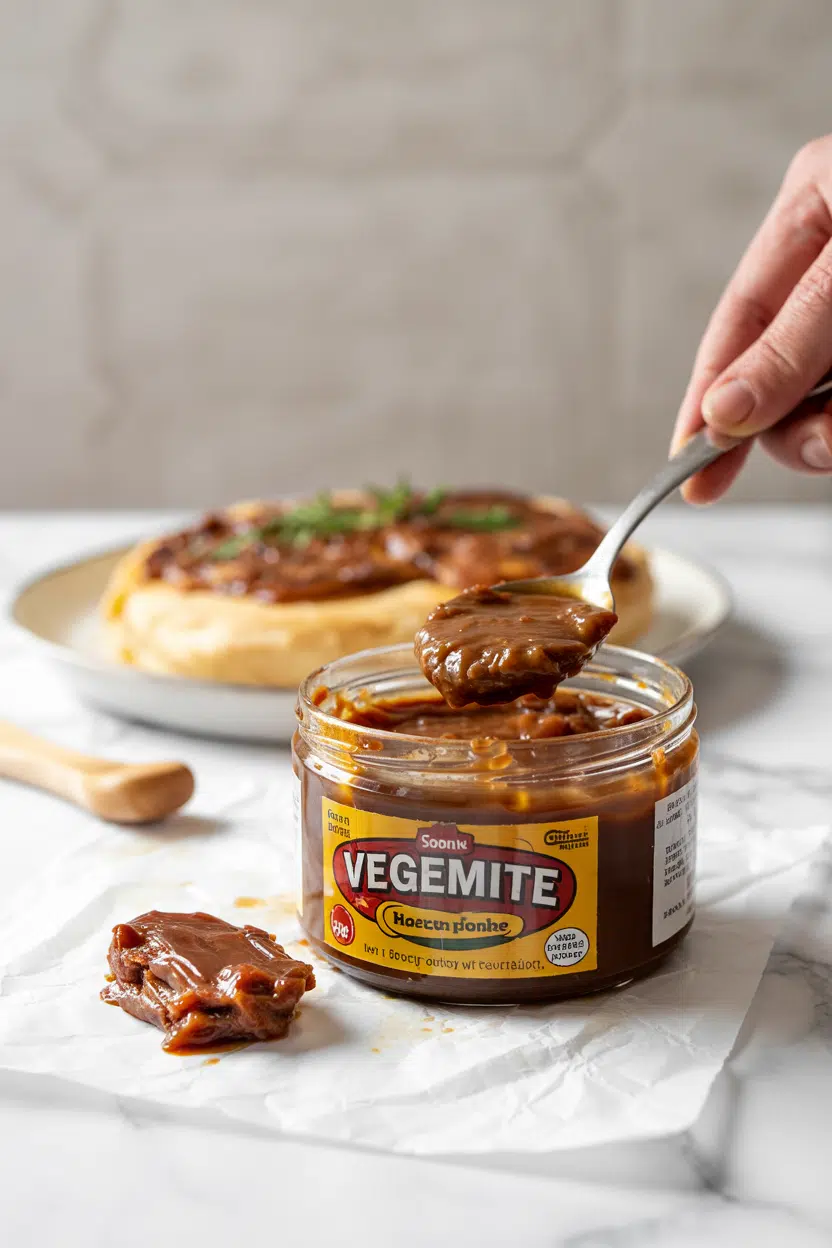
Nothing about Vegemite is subtle. The first hit is sharp saltiness, followed almost immediately by deep umami - the kind you associate with concentrated beef bouillon or a long-reduced soy braise, but without any meatiness.
Underneath the salt and savory weight sits a pronounced brewer's-yeast bitterness with faint roasted, malty undertones. That bitterness is the note that catches first-timers off guard.
Heat softens it slightly when Vegemite is dissolved into a hot liquid, but it doesn't disappear.
Spread cold on buttered toast, the paste stays sharp and assertive. Butter is not optional - it acts as a fat buffer that rounds the bitterness and distributes the intensity more evenly across the bread.
How to Use Vegemite
Most people encounter Vegemite one way: scraped thin on buttered toast. That's the correct starting point.
The ratio matters enormously - a scraping, not a spread. New users who apply it like peanut butter tend not to return for a second try.
Beyond toast, Vegemite earns its keep as a covert umami booster in cooked applications. A half-teaspoon dissolved into soup stock, gravy, or a braising liquid adds the kind of savory depth that usually requires a long simmer.
It also works stirred into mashed potatoes, folded into a savory butter, or dotted into scrambled eggs before the pan gets hot.
Classic pairings include cheddar or melted cheese on toast, fresh tomato, and eggs in any form. Australian home cooking uses it casually alongside butter or margarine; modern fusion recipes treat it the way chefs use miso or soy sauce - as a background flavor multiplier.
| Method | Best For | Tip |
|---|---|---|
| 🍞 Spread | Toast, crackers, sandwiches | Apply very thin layer over cold butter; don't skip the butter |
| 🍲 Dissolved | Soups, gravies, broths, stews | Start with ¼-½ tsp; taste before adding more |
| 🥣 Folded | Mashed potatoes, savory dips, compound butter | Mix with a fat base to distribute evenly |
| 🥩 Glaze/Marinade | Roasted meats, vegetables | Dilute with oil or broth - full strength will over-salt |
Avoid Vegemite in anything sweet or delicate. Light seafood dishes will be overwhelmed by its salt content, and it has no place near desserts.
How to Buy and Store Vegemite
Choose a jar with a firm, sealed lid and no sign of bulging or leakage. The paste inside should be uniformly dark brown; a metallic off-smell on opening or visible liquid separation signals a compromised jar.
Most supermarkets in Australia stock it in the spreads aisle, and international grocers or online retailers carry it elsewhere.
- Unopened jars - store in a cool pantry; shelf life runs many months to several years
- Opened jars - reseal tightly and keep in the pantry or fridge; pantry storage works for 6-12 months, refrigeration extends that further
- Surface drying - a thin film can form if the jar isn't sealed well; scrape it off, the paste beneath is fine
For a detailed breakdown of timelines and signs of spoilage, see vegemite storage life. If you ever run out, a handful of vegemite swaps can fill the umami gap in cooked applications.
Where to Start With Vegemite
Start with buttered toast and a scraping. That's the format the flavor was built for, and it's the version that converts skeptics.
Once you're comfortable with the intensity, move to cooked applications - a small amount in a broth or gravy is low-risk and immediately useful.
If the saltiness is a concern, butter substitutes with higher fat content can help buffer the intensity on toast. Keep the jar in the pantry, use it in small quantities, and it will last you a long time.
Frequently Asked Questions
No. Both are yeast extract spreads, however Marmite is sweeter and less bitter than Vegemite. Vegemite has a saltier, more aggressively savory profile that makes direct substitution noticeable in both raw and cooked applications.
Spread it very thin over cold butter on toast - less than you think you need. Applying too much is the most common mistake first-timers make, and the resulting intensity puts most people off permanently.
No detectable alcohol. It's made from brewer's yeast extract, not from fermented liquid, so the brewing byproduct is the yeast itself - not the beer. The finished product contains no measurable alcohol content.
It supplies B vitamins including B1, B2, B3, and folate, and some fortified versions carry B12. The sodium content is very high for its volume, so people managing blood pressure should use it sparingly.
Only in small amounts and only for umami depth - not as a direct swap. Vegemite is far thicker and more bitter, so use roughly ¼ the volume and dissolve it in warm liquid before adding it to a dish.



