
Most people assume spaghetti squash is a pasta substitute that apologetically accepts whatever sauce you pour on top.

In reality, it brings something pasta never could - a mildly sweet, nutty depth that only gets better under high heat, plus a strand structure firm enough to hold a chunky tomato sauce without collapsing.
If you're already familiar with swapping out acorn squash in winter recipes, spaghetti squash deserves a spot in that same rotation.
Spaghetti squash is a mild, slightly sweet winter squash whose cooked flesh separates into noodle-like strands. It works as a low-carb base, a simple roasted side, or a stuffed shell - and holds up to garlic, olive oil, and tomato-based sauces without getting soggy.
What Is Spaghetti Squash?
Spaghetti squash is a winter squash in the Cucurbita pepo species - the same broad family that includes zucchini and delicata squash.
Remember it later
Planning to try this recipe soon? Save it for a quick find later!
Its defining trait is its flesh: once cooked, it separates into long, pale yellow strands that genuinely resemble spaghetti noodles.
The exterior is smooth and oblong, with a rind that shifts from pale yellow to a deeper golden-orange as the squash ripens. You may also see it labeled vegetable spaghetti or spaghettini squash at some markets.
Unlike most winter squash cultivated primarily for purée or cubing, spaghetti squash was specifically adopted for its strand-forming interior.
Domesticated from New World squash lineages in North America, it gained mainstream grocery presence in the United States during the 1980s health food movement and hasn't left since.
Smaller fruits tend to yield firmer, more defined strands than large ones. For general cooking at home, aim for squash in the 2-4 pound range - big enough to feed two generously, compact enough to roast evenly.
What Does Spaghetti Squash Taste Like?
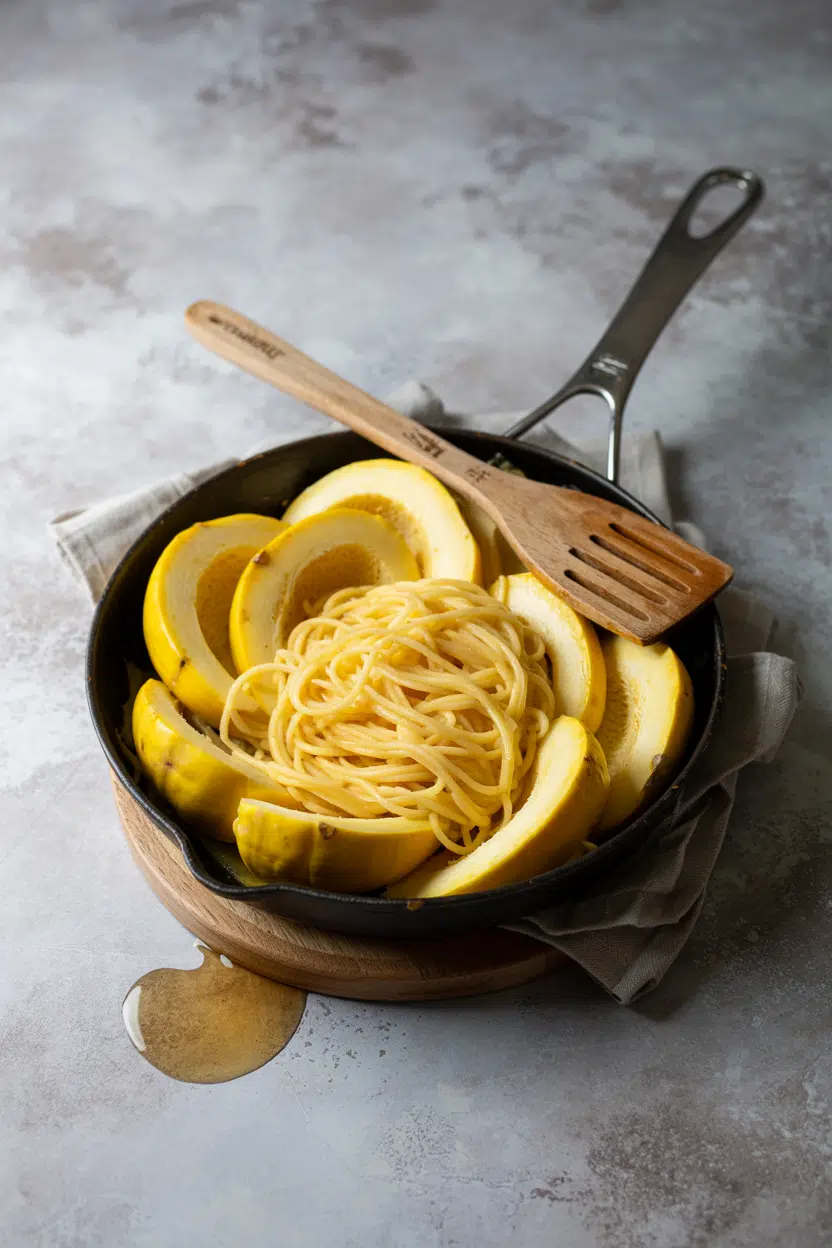
Raw spaghetti squash is starchy and barely sweet - not something worth eating as-is. Cooking unlocks the flavor.
Baked or roasted, the flesh turns mildly sweet with a faint nuttiness, especially around the edges of the cut cavity where natural sugars caramelize.
The overall profile sits somewhere between a very mild summer squash and a plain boiled potato, but lighter than both.
One practical note: steaming or microwaving produces a more neutral, watery flavor compared to roasting. If you want nuttiness, use dry heat and let the cut side caramelize before pulling it from the oven.
How to Use Spaghetti Squash
Roasting halved at 400°F (cut side down) is the standard method - it caramelizes the edges and yields strands with good texture.
Once scraped, those strands behave more like pasta than most people expect, holding chunky sauces without releasing excess water if the squash isn't overcooked.
| Method | Best For | Tip |
|---|---|---|
| 🫕 Baked whole | Easier splitting, maximum moisture retention | Pierce rind several times; bake at 375°F until skin yields to pressure |
| 🔥 Roasted halved | Best strand definition and caramelized flavor | Cut side down at 400°F; 35-45 minutes depending on size |
| ⚡ Microwaved | Weeknight speed, softer strands | Pierce and microwave whole 10-12 minutes; rest 5 minutes before cutting |
| 🥘 Sautéed strands | Finishing with garlic, butter, lemon, and herbs | Keep heat medium-high and toss briefly - 2-3 minutes max to avoid mushiness |
| 🫙 Stuffed shell | One-dish meals with meat, cheese, and vegetables | Roast first, scrape half the strands out, fill, then return to oven |
The squash pairs naturally with tomato-based sauces, garlic and olive oil, and aged hard cheeses like Parmesan or pecorino.
Mediterranean-leaning preparations - lemon zest, fresh thyme, toasted pine nuts - highlight the mild sweetness without masking it.
American home cooking leans toward butter, sage, and Parmesan as a simple roasted side, and the combination works well.
For inspiration on building a full plate around it, see our guide to sides for spaghetti squash.
Avoid heavy cream sauces that bury the squash's subtle flavor entirely. Long braises are also a problem - extended heat dissolves the strands into soft mush rather than keeping them distinct.
If you need a squash that holds up to longer cooking, consider swapping out spaghetti squash for something sturdier like butternut.
How to Buy and Store Spaghetti Squash
A good spaghetti squash feels heavy for its size and has no soft spots, cracks, or shriveled skin. The rind should be firm and matte - a slightly waxy sheen is fine, but glossy or damp patches can signal early decay.
Tap it: a hollow sound means the interior may be dry and past its prime.
For storage, whole squash keeps well - proper handling around keeping squash fresh applies here too.
Store whole at cool room temperature, away from direct sunlight, for 2-3 weeks.
Refrigerating whole squash pushes that to around a month.
Once cut, wrap tightly and refrigerate; use within 4-5 days.
For a full breakdown of timing, the guide on how long spaghetti squash keeps covers edge cases like cooked strands stored separately.
- 🛒 Rind color - Pale yellow to golden-orange; avoid greenish tinge, which signals underripeness
- ⚖️ Weight - Dense and heavy; light squash for its size often has underdeveloped flesh
- 👆 Surface - No give when pressed; soft spots mean decay has started
- ❄️ Cut storage - Wrap tightly in plastic or beeswax wrap; don't leave cut sides exposed
Start with Roasting
Roast it halved, cut side down at 400°F, and you'll understand the squash in one attempt. The strand texture, the mild caramelized sweetness, the way it takes a simple garlic-and-olive-oil finish - it all becomes clear immediately.
From there, the stuffed shell approach is the logical next step for a full weeknight meal.
Scrape half the strands, fill the cavity, and bake it again.
No extra dishes, no complicated technique.
If you need a quick workaround on a night you don't have it, swapping out butter or other finishing fats won't change the method - the squash itself is the star.
Frequently Asked Questions
Yes. It's low in calories and carbohydrates compared with pasta and provides vitamin C, fiber, and beta-carotene. It's limited in protein, so pair it with eggs, meat, legumes, or cheese for a complete meal.
It won't replicate pasta exactly - the flavor is milder and the strands are softer. Using a bold, well-seasoned sauce and salting the strands lightly after scraping closes the gap considerably.
Technically yes, but the hard rind and starchy, dense flesh make it unpleasant and difficult to eat without cooking. Raw flesh has almost no flavor and the strands don't form until heat breaks down the cell structure.
Look for a fully yellow or golden rind with no green patches, which signal underripeness. The squash should feel dense, resist all pressure when squeezed, and have a dry, corky stem end.
No. The rind acts as a natural cooking vessel - you roast or bake the squash in its shell, then scrape out the cooked strands. Peeling the raw rind is difficult and unnecessary.



