
Most people assume Locatelli is just a brand name slapped on generic Italian cheese - something you grab when Parmesan is out of stock.

That assumption costs them a lot of flavor. Locatelli is a specific sheep's milk cheese, aged and sharp in ways that cow's milk hard cheeses simply aren't, and knowing how to use it changes what you pull off the stove.
If you've been treating it as a one-to-one Parmesan swap, you're missing most of what it does - including why what pairs with cacio e pepe matters so much when this cheese is the one doing the work.
Locatelli is a Pecorino Romano sold under the Locatelli brand - a hard, aged sheep's milk cheese with a salty, sharp, sheepy bite. It's best grated over hot pasta, stirred into broths, or shaved onto salads. Stronger than Parmesan, lower in moisture, and deeply umami.
What Is Locatelli Cheese?
Locatelli is the brand name most Americans know for Pecorino Romano, a hard, aged cheese produced from sheep's milk under Italy's PDO (Protected Designation of Origin) rules.
Remember it later
Planning to try this recipe soon? Save it for a quick find later!
The cheese itself traces back to the pastoral traditions of Lazio and Sardinia - Roman shepherds were salting and aging sheep's milk wheels long before Parmesan existed.
The Locatelli company, founded in the early 20th century, became the dominant importer of Pecorino Romano into the U.S. market.
That gave the brand such recognition that many home cooks now use "Locatelli" as a generic term for the cheese itself. Pecorino Romano PDO requires aging of at least five months for table cheese and eight months for grating.
The result is a very firm, dry paste with visible white crystalline specks - tyrosine crystals that signal proper aging. You'll also see it labeled Locatelli Romano or simply Locatelli Pecorino at delis and Italian grocers.
- 🧱 Form factor - compact, dense wheels or wedges with a natural or waxed rind
- 🐑 Milk source - 100% sheep's milk, which raises protein and fat density compared to cow's milk cheeses
- 📍 PDO origin - Lazio, Sardinia, and the province of Grosseto (Tuscany) are the approved production zones
What Does Locatelli Cheese Taste Like?
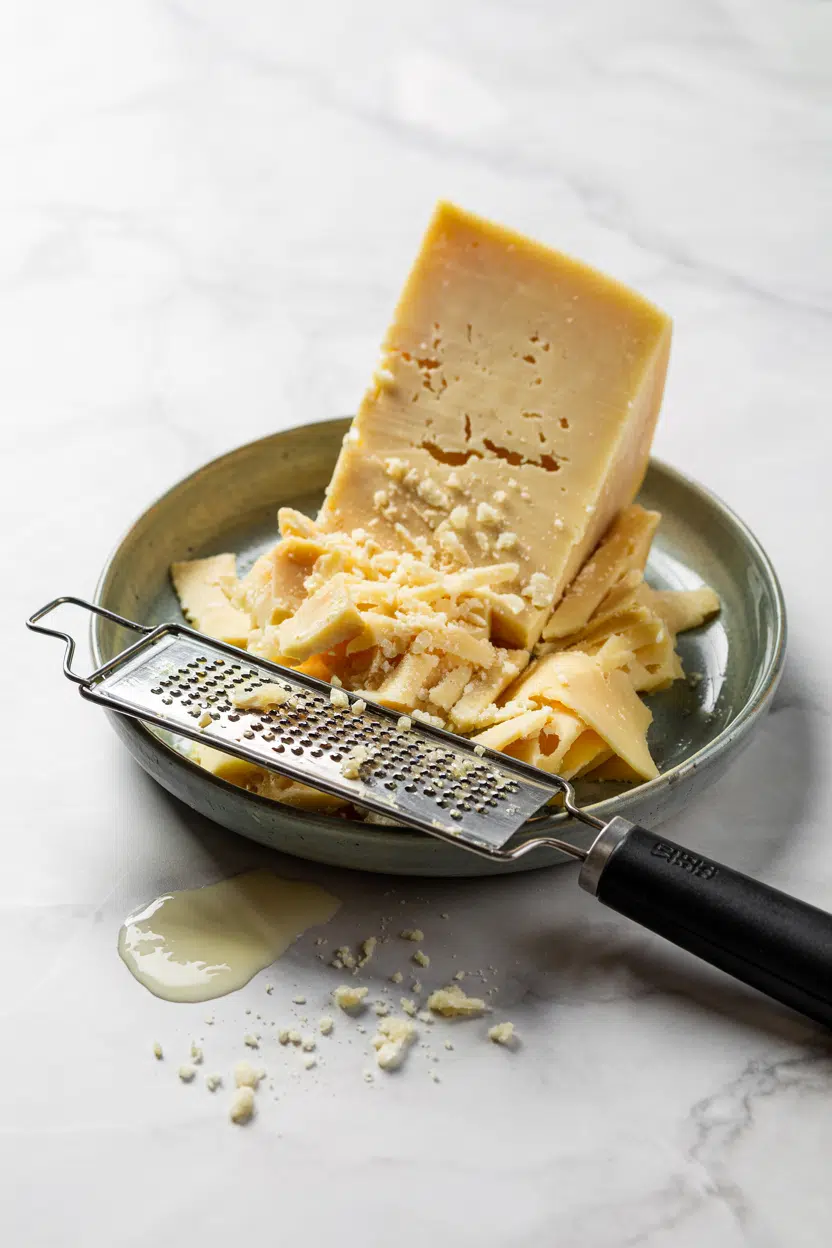
Sharp and salty are the two words that land first, but they only tell part of the story. Pecorino Romano is significantly saltier than Parmigiano-Reggiano - the curing process involves direct salting of the curd, not just brine immersion.
That sheep-forward character - a faint lanolin note that aged gouda or Parmesan simply don't carry - defines Locatelli's personality. Heat softens the sharpness slightly, letting the nuttier, more umami-forward tones come forward.
Eaten cold off a board, the salt and bite are front and center.
Compared to Parmigiano-Reggiano, Locatelli lands noticeably more aggressive in both salt and sheep funk. It's not a subtle backdrop cheese - it's the one doing the talking.
How to Use Locatelli Cheese
Locatelli earns its place in Roman pasta dishes above all else. Cacio e pepe relies on its high-fat, low-moisture structure to emulsify with pasta water and black pepper into a glossy sauce.
Grate it finely - not chunky - and add it off direct heat to prevent clumping.
Beyond pasta, it earns its spot in soups, on roasted vegetables, and in meatballs where a salty, sheepy edge sharpens the whole dish. Shaved thin with a peeler, it holds up on Caesar salad as a firmer, more pungent alternative to Parmesan.
For a cheese board, snap it into rough shards and serve with raw honey and dried figs.
| Method | Best For | Tip |
|---|---|---|
| 🧀 Shaved | Caesar salad, cheese boards | Use a vegetable peeler for thin, clean shards |
| 🍝 Grated | Cacio e pepe, pasta, pizza finish | Fine microplane grate emulsifies better in sauces |
| 🥣 Stirred in | Soups, broths, gratins | Add at the end - salt builds fast with heat |
| 🥩 Rubbed | Meat crusts before roasting | Combine with herbs and breadcrumbs for texture |
Note that locatelli cheese swaps that work are fewer than most guides suggest - the sheep's milk fat profile is hard to replicate exactly with cow's milk alternatives.
How to Buy and Store Locatelli Cheese
Buy a wedge, not a jar.
Pre-grated Locatelli loses aromatic oils quickly and often contains anti-caking agents that interfere with sauce emulsification.
Look for a wedge with a hard, dry paste, visible crystalline granules, and a rind stamped with "Pecorino Romano" or the Locatelli brand mark.
Skip anything with a wet or sticky surface, or any wedge carrying an ammonia smell.
At home, wrap the wedge in wax paper first, then loosely in a plastic bag or cheese paper to allow minimal airflow. Keep it in the warmest part of the fridge - the vegetable drawer works well.
Properly wrapped, an opened wedge holds 3-6 weeks.
The mechanics of using locatelli cheese for creaminess in sauces are closely tied to freshness - older, drier wedges emulsify less cleanly.
Start Here With Locatelli
New to this cheese? Grate it over a simple bowl of pasta with olive oil and black pepper first.
That single use demonstrates its salt level, its melt behavior, and its sheep-forward bite all at once - and tells you immediately how much restraint the dish needs.
From there, scale up to cacio e pepe or roasted vegetables.
The comparison between Locatelli and its cow's milk counterpart is worth understanding too - using parmesan vs parmigiano reggiano for creaminess shows exactly where the textures diverge.
Frequently Asked Questions
Yes. Locatelli is the brand name; the cheese itself is Pecorino Romano PDO. The Locatelli company became the dominant U.S. importer of this cheese, which is why the brand name stuck as a shorthand.
You can, but use about 25% less - Locatelli runs significantly saltier than Parmesan. The sheep's milk also gives it a sharper, more assertive edge that reads differently in mild dishes.
Very salty. Pecorino Romano is one of the saltiest aged cheeses in common use - the curd is directly salted during production, not just brined. One ounce can contain 200-250 mg of sodium.
Traditionally, yes. Pecorino Romano PDO uses animal rennet, making it unsuitable for strict vegetarians. Check the label if this matters - some producers now offer vegetarian-rennet versions.
You can freeze grated Locatelli for up to three months - it thaws well for cooking but turns too crumbly to shave. Wedges freeze acceptably, though the texture becomes slightly more granular after thawing.



