
You spot it at the market and hesitate - that glossy, deep-purple globe sitting next to the bell peppers and zucchini. Eggplant looks confident on the outside, however many cooks aren't sure what to do with it once they get it home.

That uncertainty is understandable. Eggplant's spongy flesh behaves differently from almost any other produce - it soaks up fat and flavor like a sponge, collapsing from dense and raw into something genuinely silky.
Get that right, and dishes like moussaka, baba ganoush, and baingan bharta make a lot more sense.
Eggplant - also called aubergine or brinjal - is a mildly flavored nightshade with spongy flesh that turns silky under heat. It absorbs oils and sauces readily, making it ideal for roasting, frying, and braising across Mediterranean, Middle Eastern, and South Asian cuisines.
What Is Eggplant?
Eggplant is a nightshade fruit - botanically a berry - though every cuisine in the world treats it as a vegetable. It was first domesticated in India and spread through Southeast Asia before Arab traders carried it into the Mediterranean basin during the Middle Ages.
Remember it later
Planning to try this recipe soon? Save it for a quick find later!
You'll find it sold under several names depending on where you shop. In the UK and much of Europe it's aubergine; across South Asia and parts of Africa it's brinjal or baingan.
Varieties differ significantly in size and behavior:
- Globe eggplant - the large, bulbous type most common in North American supermarkets; best for thick slices, baking, or frying
- Japanese eggplant - long and slender with thinner skin; cooks faster and has a slightly sweeter, less bitter flavor
- Italian eggplant - smaller than globe, with a thinner skin and fewer seeds; holds its shape well when sliced
- Thai eggplant - small, round, and firm; used whole in Southeast Asian curries, with a notably more bitter edge
All share the same defining characteristic: white, spongy flesh with small edible seeds that becomes progressively creamier as heat is applied.
What Does Eggplant Taste Like?
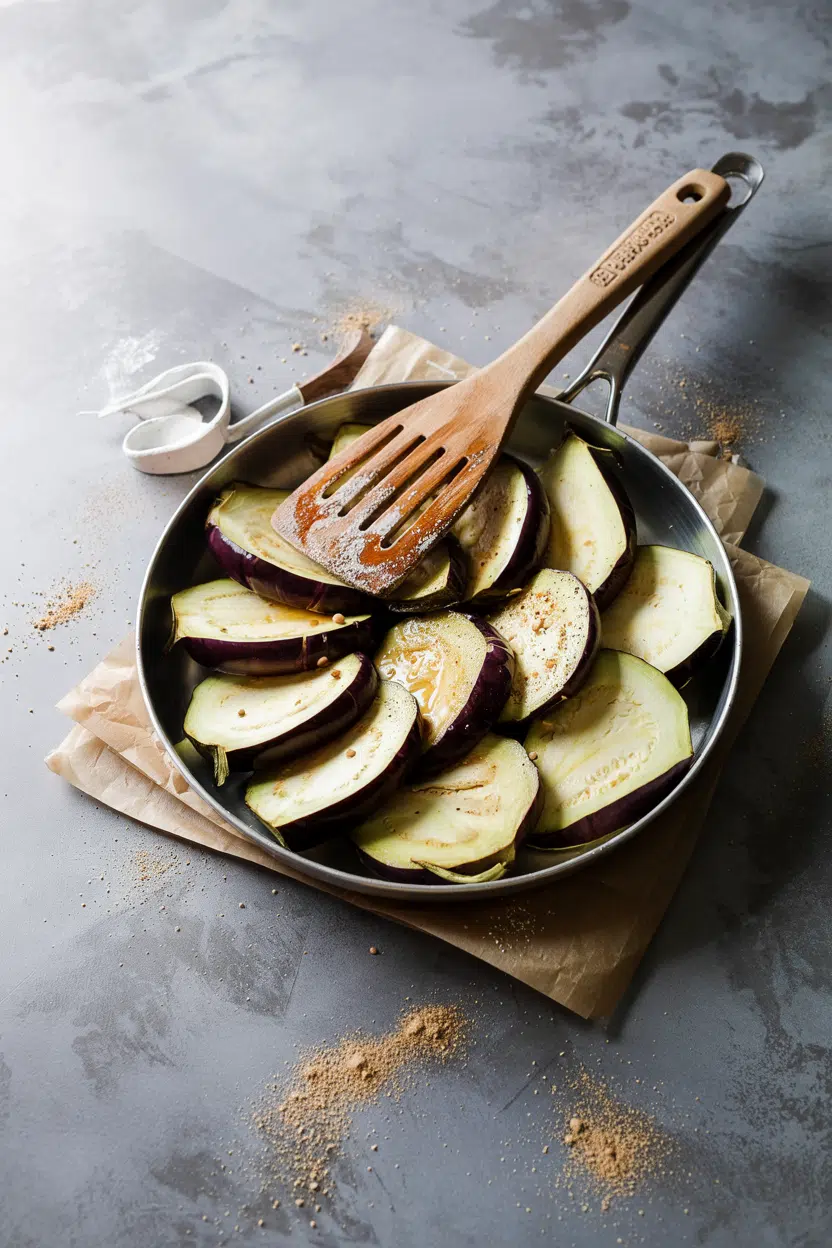
Raw eggplant tastes mild with a faint bitterness, most noticeable near the seed pockets. That bitterness softens significantly once heat is applied.
Roast it at high heat and the flavor shifts into something richer - earthy and umami-forward, closer to roasted mushrooms than anything else in the produce aisle. Grill it and you get a smoky, slightly sweet edge on top of that same earthiness.
The texture shift matters as much as flavor. Cooked correctly, the flesh becomes almost creamy - a quality that makes it work so well in dips like baba ganoush or as a layering element in moussaka.
Undercooked, it stays spongy and slightly unpleasant.
How to Use Eggplant
Eggplant earns its place across more cuisines than almost any other vegetable, largely because its neutral base flavor adapts to bold seasonings without fighting back.
Mediterranean cooks lean on olive oil, garlic, and tomato; South Asian cooks use it with cumin, turmeric, and chili; East Asian cooks pair it with soy, sesame, and ginger.
The key is matching the cooking method to what you want the eggplant to do.
| Method | Best For | Tip |
|---|---|---|
| 🔥 Roasting | Baba ganoush, dips, salads | Roast whole directly over flame or under broiler for smoky flesh |
| 🍳 Pan-frying | Moussaka layers, caponata | Salt slices first to draw out moisture before frying |
| 🥘 Braising | Baingan bharta, curries, ratatouille | Cut into chunks; let it absorb the cooking liquid fully |
| 🫙 Baking | Eggplant parmesan, stuffed eggplant | Pre-bake slices before layering to avoid watery final dish |
| 🥢 Stir-frying | Asian-style dishes with soy and chili | Use Japanese or Chinese varieties; they cook faster and hold shape |
Eggplant pairs cleanly with tomato, garlic, tahini, lemon, and olive oil - the backbone of dishes like caponata and baba ganoush. It also takes well to mozzarella and feta, which is why it appears so often in baked Mediterranean preparations.
If you need a swap for a specific recipe, eggplant alternatives depend heavily on whether you need the absorbency, the bulk, or just the mild flavor profile. For side-dish pairing ideas, pairings for caponata covers the full spread.
How to Buy and Store Eggplant
Pick eggplants that feel firm and heavy for their size, with smooth, glossy skin and a tight, bright-green calyx at the stem. Wrinkled skin, soft spots, or brown scarring all signal an eggplant past its window.
Storage is straightforward once you know eggplant's one sensitivity: ethylene gas. Keep it away from bananas, apples, and other ethylene-producing fruits, which accelerate softening.
- Room temperature - whole, uncut eggplant keeps 1-3 days on the counter in a cool spot
- Refrigerator crisper - wrap in a paper bag (not plastic) and store up to 5 days; plastic traps moisture and speeds decay
- Cut eggplant - use within 1 day; flesh browns quickly once exposed to air
For a full breakdown of timing by variety, the eggplant freshness guide guide covers globe, Japanese, and Italian types separately.
Start Here If You're New to Eggplant
Don't start with eggplant parmesan or moussaka - both require multiple steps and are unforgiving if the eggplant isn't properly cooked first. Start with roasting.
Halve a globe eggplant, brush with olive oil, and roast cut-side down at high heat until completely tender. That single technique shows you exactly how the texture transforms - and the result is side dishes for moussaka territory once you're ready to go further.
Once roasting is easy, move to pan-frying with salted slices, then into braised preparations. The learning curve is short once you understand what heat does to the flesh.
Frequently Asked Questions
Botanically it's a fruit - specifically a berry that develops from the plant's flower. Every cuisine treats it as a vegetable, however, because its flavor and texture behave like one in savory cooking.
Salting draws out moisture so the eggplant fries or sautés instead of steaming in its own liquid. It also firms the flesh slightly, which helps it hold shape during pan-frying rather than collapsing into mush.
Modern cultivars are much less bitter than older varieties. Any residual bitterness concentrates near the seeds and softens with heat; salting before cooking reduces it further.
Salt sliced eggplant for 20-30 minutes, then pat dry before cooking. For baked dishes like eggplant parmesan, pre-bake or pan-fry the slices first to drive off moisture before layering with sauce.
Yes - and it's worth keeping. The skin of eggplant contains nasunin, a polyphenol antioxidant that may protect cell membranes. Thin-skinned Japanese and Italian varieties are easiest to eat with skin on; large globe skin can turn chewy when baked.



