
Most people treat burrata the way they treat fresh mozzarella - sliced cold, plated quickly, eaten without much thought. That's a missed opportunity, because burrata is a fundamentally different product with a different payoff.

Burrata is a fresh Italian cheese with a thin mozzarella-like shell and a loose, creamy interior of stracciatella. It's mild, milky, and rich - best served raw at room temperature, cut open at the table, and eaten within days of purchase.
What Is burrata cheese?
Burrata originated in Puglia, the heel of Italy's boot, and the name translates roughly to "buttered." It belongs to the pasta filata family - the same stretched-curd tradition that produces mozzarella - but the construction is more complex.
Remember it later
Planning to try this recipe soon? Save it for a quick find later!
Cheesemakers form a thin pouch from fresh curd, fill it with stracciatella (shredded mozzarella-style curd mixed with cream), then seal the top.
The result is two textures in one cheese. The outer shell behaves like a soft, elastic fresh mozzarella.
The interior is entirely different: loose, silky, and slightly stringy, releasing a rush of cream the moment the shell is broken.
You may also see it labeled burrata di Andria, referencing the Apulian town where the style is said to have been developed in the early twentieth century. Most commercial versions are now produced across Italy and internationally, though Puglia remains the benchmark.
- 🏷️ Other names - burrata di Andria, fresh burrata
- 🥛 Outer shell - pasta filata curd, mild and elastic like fresh mozzarella
- 🌀 Interior filling - stracciatella: pulled curd ribbons suspended in heavy cream
- 📦 Sold as - individual balls in a whey or cream brine, sealed tub or pouch
What Does burrata cheese Taste Like?
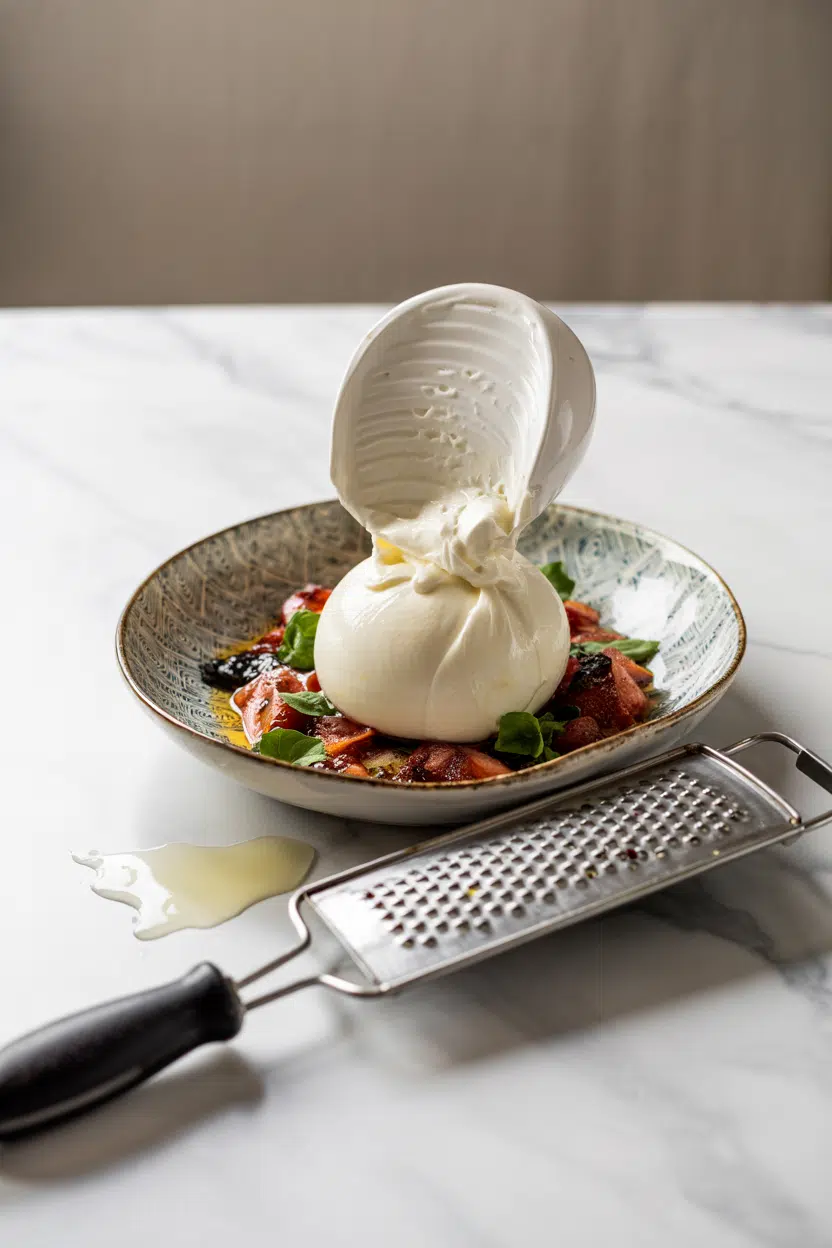
The outside tastes close to fresh mozzarella - clean, mildly milky, with a faint lactic tang and almost no sharpness. Cut it open, and the interior shifts register entirely.
The stracciatella filling delivers a richer, fattier creaminess that reads somewhere between ricotta and whipped cream, grounded by that same milky sweetness.
Temperature matters significantly here. Served cold from the fridge, the cream inside stiffens and the shell turns rubbery. At room temperature, the shell softens and the center loosens into something that pours gently onto whatever it touches. That contrast - elastic shell giving way to flowing cream - is the whole point.
Aroma is subtle: fresh milk, a light grassy note, nothing assertive.
How to Use burrata cheese
Burrata's greatest advantage is also its constraint: heat ruins it. This is not a melting cheese in the traditional sense.
Long exposure to direct heat dissolves the cream, collapses the stracciatella, and strips out what makes it worth buying. Every technique worth using keeps it raw or adds it at the very last second.
The most straightforward approach is also the best. Place a whole ball on a plate, drizzle with good extra-virgin olive oil, add flaky salt and cracked pepper, and let people break it open themselves.
With ripe heirloom tomatoes and fresh basil, it functions as a richer caprese - no other changes needed.
Warm applications work when timed correctly. Spoon it over just-cooked pasta off the heat, and the cream loosens into a light sauce without fully cooking. The same logic applies to pizza: add it after baking, not before. On toasted sourdough or crostini, it pairs well with prosciutto, stone fruit jam, or thin slices of grilled peach and fig.
Avoid pairing it with very spicy or heavily sauced dishes. The delicate cream gets lost entirely beneath bold flavors.
If you need a burrata cheese substitute for a cooked application, fresh ricotta or stracchino holds up to heat better.
| Method | Best For | Tip |
|---|---|---|
| 🥗 Raw at Room Temp | Plated whole, caprese-style salads, crostini | Serve within 30 min of pulling from fridge |
| 🍝 Last-Minute Spoon | Warm pasta, grain bowls, roasted vegetables | Add off heat; residual warmth is enough |
| 🍕 Post-Bake Finish | Pizza, flatbreads, toasted crostini bases | Place on top after removing from oven |
| 🍑 Sweet Pairings | Grilled peaches, figs, fruit-forward platters | A drizzle of balsamic ties the contrast together |
How to Buy and Store burrata cheese
Look for a ball stored in clear whey or cream brine, with an intact, unbroken shell and no yellowing. White, slightly glossy, and firm to the eye - that's what fresh looks like.
Check the pack date and prioritize the most recently produced tub. When possible, choose Italian-origin products, particularly those noting Puglia or Andria provenance.
Once opened, use it the same day or within two to three days at most. burrata cheese freshness guide drops quickly once the seal is broken and the cream is exposed to air. Unopened tubs typically hold for 7-10 days from the pack date, similar to how fresh cream behaves in storage.
Do not freeze it - the cream separates and the shell texture does not recover.
Understanding how fresh cheese is made explains why burrata degrades faster than aged varieties: there's no rind, no acid barrier, and the fat-rich filling is especially prone to spoilage once exposed.
Buy It Fresh, Use It Fast
Burrata rewards the cook who plans around it rather than leaving it as an afterthought. If the pack date is more than a week old, pass. If it's fresh, buy it the day you plan to serve it.
Use it on something simple - a plate with good olive oil, ripe tomatoes, and crusty bread - before experimenting with warm applications. The straightforward version reveals what you're working with.
Once you've tasted it at its best, the other uses follow naturally.
Frequently Asked Questions
No. The outer shell is similar to fresh mozzarella, but the interior is stracciatella - shredded curd mixed with heavy cream. That filling makes burrata significantly richer and creamier than mozzarella throughout.
Serve it whole at room temperature, then cut or tear it open at the table so the cream spills out. Flaky salt, olive oil, and something acidic like tomato or a balsamic drizzle are all it needs.
Yes, with limits. It works in warm dishes only when added off the heat - spooned over pasta or placed on pizza after baking. Direct heat dissolves the cream and destroys the texture entirely.
Unopened, most tubs last 7-10 days from the pack date. Once opened, use it within 2-3 days. Keep it submerged in its liquid - exposure to air accelerates spoilage. See our full burrata storage guide guide for details.
Yes - more so than most fresh cheeses, because of the cream mixed into the stracciatella filling. It fits low-carb diets in portioned servings but is not suitable for dairy-free or vegan eating plans.



