
You spot it on the shelf between xanthan gum and tapioca starch - a small packet labeled "agar agar" or sometimes just "kanten." Maybe you're replacing animal gelatin in a recipe, or trying to make a dessert that won't melt at a summer party. Agar agar is a plant-based gelling agent extracted from red algae, and it behaves differently from anything else in your pantry.
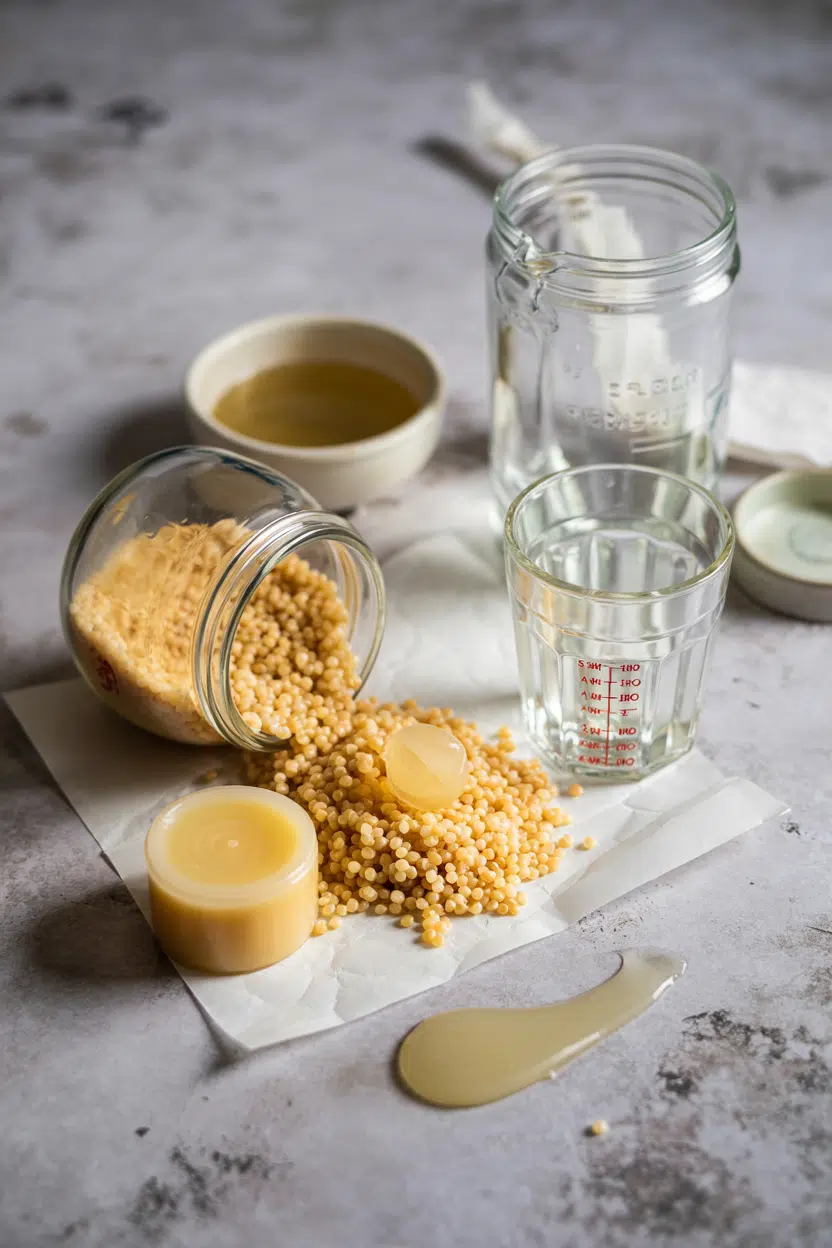
Understanding those differences is what makes it work.
Agar agar is a seaweed-derived gelling agent from red algae. It sets firmer and more brittle than gelatin, holds at room temperature, and has a nearly neutral flavor. Available as powder, flakes, or bars, it's the standard vegan swap for gelatin in desserts, aspics, and molded sweets.
What Is agar agar?
Agar agar is a polysaccharide - a chain of complex carbohydrates - extracted from the cell walls of red algae, primarily species like Gelidium and Gracilaria.
Remember it later
Planning to try this recipe soon? Save it for a quick find later!
It has been used in East Asian cooking for centuries, first formalized in Japan during the 17th century under the name kanten.
It goes by several names: agar, agar-agar, kanten, and China grass. All refer to the same substance in different forms.
- Powder - the most precise form; dissolves quickly and measures easily by the teaspoon
- Flakes - less concentrated than powder; require longer simmering and use roughly 3× the volume
- Bars - traditional dried form, common in Japanese markets; soak before use
Unlike gelatin, which comes from animal collagen, agar is fully plant-derived and sets without refrigeration.
It also gels at a higher temperature - around 95°F (35°C) - meaning a panna cotta or aspic made with agar stays firm on a warm plate where gelatin would not.
What Does agar agar Taste Like?

Agar agar is essentially tasteless. That's one of its main strengths as a gelling agent - it doesn't compete with whatever liquid it's setting.
At standard recipe quantities (roughly 1-2 teaspoons per cup of liquid), you won't detect any flavor at all. Use it in excess, however, and a faint vegetal, sea-like minerality can come through - not unpleasant, but noticeable.
The texture is where agar diverges sharply from gelatin. A set agar gel snaps cleanly rather than wobbling or stretching - think firm tofu more than Jell-O.
This makes it ideal for slicing layered desserts or unmolding shapes that need to hold an edge.
How to Use agar agar
Agar agar earns its place across Japanese, Chinese, Southeast Asian, and modernist kitchens. The most traditional applications are kanten - a firm, lightly sweetened Japanese jelly - and yokan, a dense red bean confection that uses agar to achieve its characteristic dense, sliceable block.
Beyond those classics, agar handles a wide range of modern applications well.
| Method | Best For | Tip |
|---|---|---|
| 🍳 Boiled & Set | Fruit jellies, kanten, molded desserts | Boil at least 2 min to fully activate; pour into molds while still liquid |
| 🥣 Simmered Savory | Aspics, consommés, savory gels with dashi or soy | Strain through fine mesh before pouring to remove any undissolved bits |
| 🍮 Chilled Mold | Vegan panna cotta, layered dessert sheets | Sets at room temp; refrigerate for a firmer, cleaner slice |
| 🔬 Molecular | Shaped gels, hot gels, spherification variations | Agar gels survive temperatures up to ~185°F - gelatin cannot |
Fruit pairings that work especially well include citrus juices, apple, and berry - all of which set clearly without discoloring. Coconut milk and oat milk make for rich, creamy gels.
For savory uses, dashi and a touch of soy sauce create an aspic that holds its shape at room temperature on a warm plate.
One pairing to avoid: raw tropical fruits. Pineapple, kiwi, and papaya contain proteolytic enzymes that break down the gel structure.
Cook them first, and the problem disappears.
How to Buy and Store agar agar
Agar powder is the most reliable form for home cooking. It measures precisely, dissolves faster than flakes, and produces consistent results. Look for fine, uniform powder - no clumps, no darkened particles, and no moisture in the packet.
Labels sometimes say "kanten" rather than agar-agar - both are the same product. Flakes work in a pinch but require more volume and longer simmering, which affects the final gel clarity.
For storage, keep agar in an airtight container in a cool, dry pantry away from direct sunlight. Humidity is the only real enemy - it causes clumping and weakens gel strength.
Stored correctly, powdered and flake agar keep well for 2-3 years. Bars last similarly as long as they're fully dried and wrapped between uses.
Start Here with agar agar
If you're new to agar, begin with a simple fruit juice jelly - it shows you exactly how the gel behaves without involving other variables. Once you understand the snap and firmness, move to layered desserts or vegan panna cotta.
Those switching from gelatin should know that agar is not a straight 1:1 swap. Use roughly one teaspoon of agar powder for every tablespoon of gelatin powder, and expect a firmer, less elastic result.
If you need more flexibility, look at agar substitutes that offer different textures for different applications.
Frequently Asked Questions
No. Agar is roughly three times stronger than gelatin by volume. Use about one teaspoon of agar powder in place of one tablespoon of gelatin powder. The set will be firmer and less elastic.
Not at normal quantities. At standard recipe amounts, agar is virtually flavorless. A very faint mineral note can appear if you use more than the recipe calls for.
The most common cause is underdissolving - agar must reach a full boil for at least two minutes. Acidic liquids can also weaken the gel; add citrus juice after boiling and just before pouring into molds.
Whisk agar powder into cold liquid first, then bring to a full boil while stirring. This prevents clumping and ensures even hydration before the gelling process begins.
No - both are plant-based gelling agents, but they behave differently. Pectin comes from fruit cell walls and typically requires sugar and acid to gel. Agar gels without either, and sets much firmer.



