
Amaro Montenegro earns its place in a bottle collection not because it's the most complex amaro on the shelf, but because it bridges two worlds - the bitter aperitif side and the sweet digestif side - with more grace than almost anything in its category.

It sits at 23% ABV, lower than most spirits, making it approachable for cooking, mixing, and sipping without the alcohol heat getting in the way.
Experienced amateurs reaching for a classic italian negroni recipe or building a Montenegro Spritz as an alternative to making italian aperol spritz cocktail at home will find this Bologna-born liqueur rewarding from the first pour.
It also pairs well with Prosecco - and for those exploring pairing ideas for prosecco, Amaro Montenegro is one of the stronger candidates in that conversation.
Amaro Montenegro is a bittersweet Italian herbal liqueur from Bologna, made from a proprietary botanical blend. At 23% ABV, it's lower-proof than most amari, with orange-forward flavor, soft vanilla warmth, and gentle bitterness. It works as a digestif, cocktail ingredient, and cooking addition.
What Is Amaro Montenegro?
Amaro Montenegro is a proprietary Italian bitter liqueur first produced in Bologna in 1885 by Stanislao Cobianchi, who named it after Princess Elena of Montenegro. It belongs to the amaro category - Italian herbal liqueurs traditionally consumed as digestifs - but sits at the lighter, sweeter end of the spectrum.
Remember it later
Planning to try this recipe soon? Save it for a quick find later!
The exact botanical formula is a closely guarded recipe, though the brand confirms over 40 botanicals including orange peel, vanilla, juniper berries, eucalyptus, and aromatic roots.
Most amari are regionally distinct, and Montenegro's origins in Emilia-Romagna give it that region's characteristic balance of warmth and refinement.
It's also sold under the name Amaro di Montenegro and frequently misspelled as "Amaro Montengro." Unlike heavier amari such as Averna or the intensely bitter Fernet-Branca, Montenegro reads more like an orange-vanilla digestif with herbal undertones than a medicinal spirit.
- 🇮🇹 Origin - Bologna, Emilia-Romagna, Italy; produced continuously since 1885
- ABV - 23%, lower than most amari and standard spirits
- Style - Sweet-leaning amaro; orange-forward with herbal backbone
- Alternate names - Montenegro, Amaro di Montenegro, occasionally "Montenegro amaro"
What Does Amaro Montenegro Taste Like?
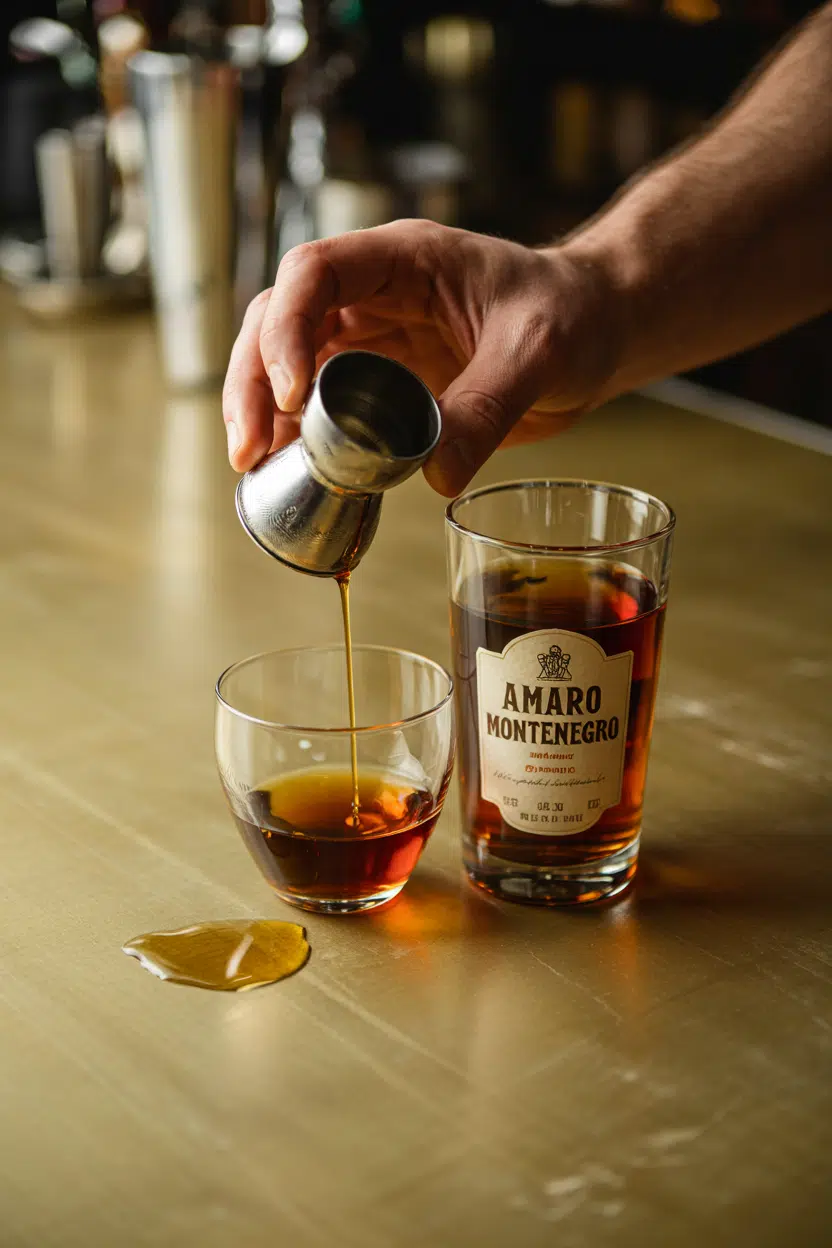
Amaro Montenegro opens with bright orange peel - the dominant note - backed immediately by soft vanilla and a caramel warmth that keeps the bitterness in check.
That bitterness does arrive, but it's gentle: faintly juniper-like and slightly eucalyptus-adjacent rather than sharp or medicinal.
The syrupy, silky mouthfeel distinguishes it from drier amari - it coats the palate without being cloying. Compared to Campari, Montenegro is less sharp and far less astringent.
Against Fernet-Branca, it barely registers as medicinal.
In cooking, heat amplifies the caramel and spice notes while pulling back some citrus brightness, which is worth accounting for when using it in glazes or warm drinks.
How to Use Amaro Montenegro
Montenegro's most traditional role is as a post-dinner digestif - served neat at room temperature or over a single large ice cube. That's still its strongest showing.
However, the cocktail world has embraced it for good reason: the orange-vanilla profile integrates cleanly into both stirred and built drinks.
| Method | Best For | Tip |
|---|---|---|
| 🥃 Neat / On Ice | Digestif, slow sipping | Serve at room temperature or with one large cube - dilution opens the botanicals |
| 🍹 Cocktails | Spritz, Montenegroni, low-ABV builds | Swap for Aperol in a spritz for more orange depth; replace Campari in a Negroni for softer bitterness |
| 🍯 Reduction / Glaze | Roasted pork, duck, game meats | Reduce with honey over low heat; stop when it coats a spoon - it thickens further off heat |
| 🍐 Poaching Liquid | Pears, stone fruit | Add to a light sugar syrup with a strip of orange peel; simmer fruit gently for 15-20 minutes |
| 🎂 Baking | Sponge cake soaks, custards, ganache | Use sparingly - a tablespoon adds orange-vanilla aroma without making desserts taste boozy |
In Italian-style aperitivo settings, Montenegro works beautifully alongside Prosecco. Modern European bistro cooking uses it in chocolate desserts - a small pour stirred into ganache or folded into mousse adds complexity without an obvious alcohol note after setting.
Dark chocolate, blood orange, and roasted coffee are the three pairings that work most reliably across applications. Avoid pairing it directly with very bitter greens; the combination doubles down on bitterness without balance.
Those exploring swapping out amaro montenegro will find the closest matches are other sweet-leaning amari, though none replicate the specific orange-vanilla pairing exactly.
For cocktail builds using bitters as a base, the broader guide to alternatives to campari covers several overlap options.
How to Buy and Store Amaro Montenegro
Identify the correct bottle by its distinctive orange-trim label, amber-colored liquid, and the 23% ABV marking on the front. Avoid bottles with cloudiness, sediment, or faded labels - these signal poor storage or questionable provenance. If buying older vintages, check for an intact manufacturer seal or tax stamp.
Store opened bottles upright in a cool, dark location, away from direct sunlight or heat sources.
The lower ABV means it's more vulnerable to flavor degradation than higher-proof spirits, so resealing the cap tightly matters more here than with a 40% whisky.
Opened bottles hold well for 1-3 years; flavor softens gradually after that without becoming unsafe. For guidance on detecting deterioration, check the full breakdown of amaro montenegro spoilage signs.
If you're also working with vanilla-forward baking projects alongside this liqueur, the guide on replacements for vanilla sugar can fill gaps when the two flavors overlap.
Where to Start With Amaro Montenegro
Neat over ice is the entry point. One pour after dinner tells you more about the bottle than any cocktail will.
From there, the Montenegroni - a Negroni with Montenegro replacing Campari - is the most useful next move for cocktail builders. It shows the liqueur's range quickly.
- 🍊 Start here - Neat at room temperature, after a meal
- 🍹 First cocktail - Montenegro Spritz: Montenegro, Prosecco, splash of soda, orange slice
- 🍯 First cooking use - Honey-Montenegro glaze over roasted duck or pork tenderloin
- 🎂 For bakers - One tablespoon stirred into chocolate ganache before setting
Those who find Montenegro too sweet for neat sipping will get more from it in cooking, where the sugar drives the glaze and the botanicals contribute the character.
Frequently Asked Questions
Both, but sweetness leads. The orange peel and vanilla notes dominate upfront, with bitterness arriving as a soft finish rather than a sharp hit. It's considerably sweeter than most amari.
It's 23% ABV - lower than most spirits and amari, which typically range from 28-35%. That lower proof makes it more suitable for cooking and light cocktail builds where alcohol heat would be intrusive.
The Montenegroni (Montenegro replacing Campari in a Negroni) and the Montenegro Spritz (with Prosecco and soda) are the two most common builds. It also appears in low-ABV stirred cocktails and paper-plane riffs.
Meletti or Ramazzotti are the closest substitutes - both orange-forward with moderate sweetness. For cocktails needing more bitterness, Aperol can stand in for spritz applications, though it lacks the herbal depth.
Yes - it reduces well into glazes and infuses cleanly into custards, syrups, and cake soaks. Use no more than one to two tablespoons in baked goods; heat concentrates the sweetness and can overwhelm delicate flavors.



