
Most people dismiss hoop cheese as a primitive forerunner to "real" cheese - something that disappeared when supermarket dairy took over.

That assumption misses the point entirely.
Hoop cheese never stopped being useful, and cooks who grew up with it in Appalachian kitchens or Midwestern farm communities know it holds its own against any fresh dairy product.
It fits naturally alongside the kind of dishes alongside cornbread that built American farmhouse cooking, and it earns a place on modern boards and skillets with equal confidence.
Hoop cheese is a fresh pressed cow's milk cheese with a mild lactic tang, clean finish, and firm but yielding texture. It's sliceable straight from the wheel, takes light heat without falling apart, and suits everything from sandwiches to scrambled eggs. Best used within two weeks.
What Is hoop cheese?
Hoop cheese comes from one of the oldest cheesemaking traditions in American farm life. Whole cow's milk curds are ladled into a cheese hoop or mold, then drained and pressed until the whey is expelled and the paste firms into a sliceable wheel.
Remember it later
Planning to try this recipe soon? Save it for a quick find later!
No aging, no rind, no added cultures beyond what produces the initial lactic fermentation.
It originated in Southern and Appalachian communities and Midwestern farm households where fresh, unaged cheese was a practical staple - made quickly, eaten quickly.
You'll still find it sold in rounds or wedges at farmstead dairies and regional markets, often wrapped simply in wax paper.
Regional naming gets confusing fast. Some grocers label it farmer's cheese, which is accurate in spirit but imprecise - farmer's cheese can refer to several pressed fresh styles. "Pressed cheese curd" is a more literal description.
Whatever the label, the defining feature is its production method: a hoop mold, minimal processing, and whole milk.
- 🧀 Milk source - whole cow's milk, not skimmed or blended
- 🔄 Production - curd is pressed in a hoop mold, not stirred or cultured like cottage cheese
- 📍 Origin - Southern U.S., Appalachia, and Midwestern farm communities
- 🏷️ Alternate names - farmer's cheese (regional), pressed cheese curd
What Does hoop cheese Taste Like?
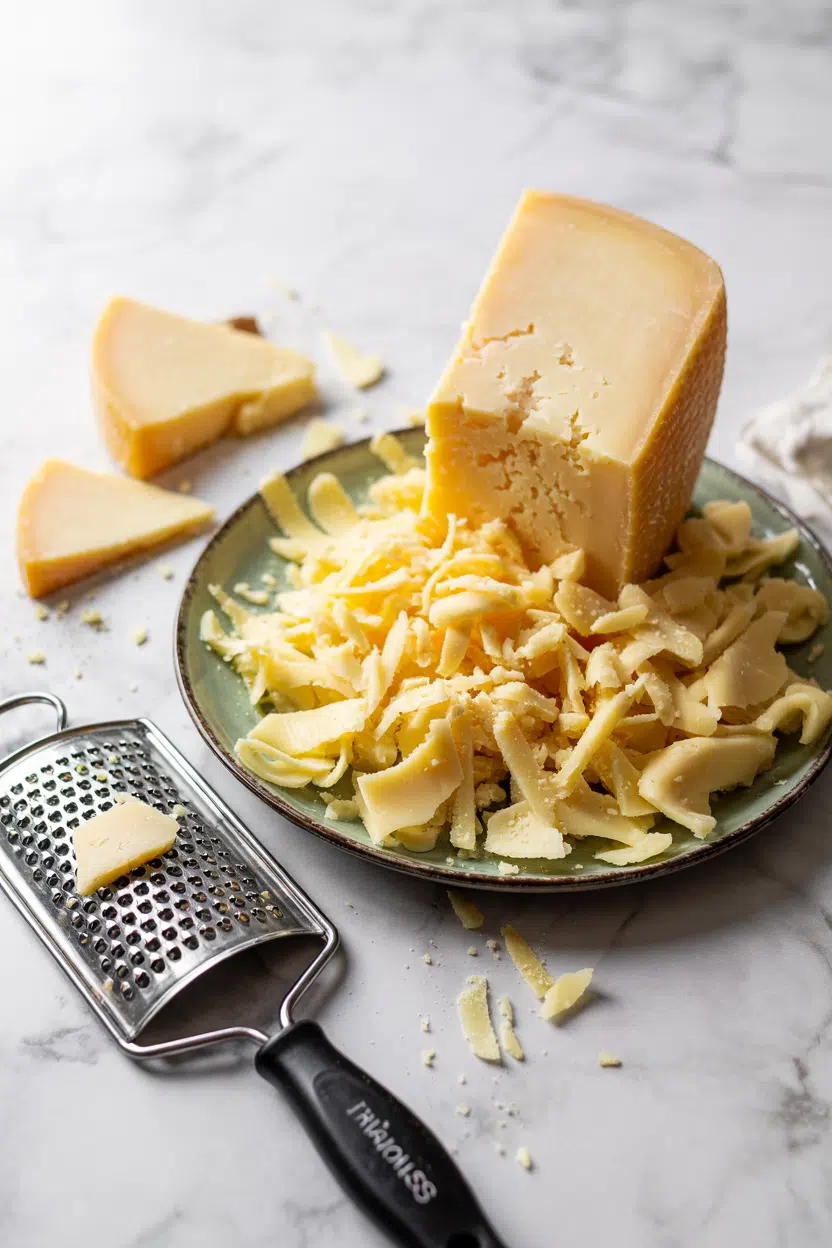
Hoop cheese reads mild on every level, but mild doesn't mean flat. The dominant note is a clean lactic tang - the same brightness you get from good plain yogurt, but gentler and backed by a soft milky sweetness.
The finish is slightly acidic without puckering.
Compared to its closest relatives, hoop cheese sits between pressed ricotta and farmer's cheese in texture - firmer than either, without the crumble of dry ricotta or the moisture pooling of cottage cheese.
It's far less salty than feta, which means the natural dairy character comes through unmasked.
Heat doesn't melt it the way cheddar melts. It softens at the edges and warms through, but holds its shape - a quality that makes it reliable in the pan.
How to Use hoop cheese
Hoop cheese doesn't require much. Its firm, smooth texture makes it a natural for slicing straight onto a sandwich - ham or smoked turkey are the traditional pairings, and they still work.
The cheese holds together cleanly without tearing or crumbling mid-bite.
| Method | Best For | Tip |
|---|---|---|
| 🥗 Raw/Sliced | Sandwiches, cheese boards, salads | Slice at room temperature for cleanest cuts |
| 🍳 Pan-Fried | Warm side with grits or cornmeal, quesadillas | Use medium heat - it softens but won't fully melt |
| 🥚 Crumbled/Stirred | Scrambled eggs, omelets, mashed potatoes | Add at the end of cooking to preserve tang |
| 🧂 Crumbled as Topping | Tomato and cucumber salads, grain bowls | Pairs well with pickled onions or crisp vegetables |
On a country-style cheese board, hoop cheese earns its place alongside crisp pickles, fig or peach preserves, and raw apple or pear slices.
The slight tang cuts through sweet preserves; the mild dairy body softens the brine of a good pickle.
Cornbread and buttermilk biscuits are natural companions - if you want to round out the spread, ideas for dishes alongside cornbread extend that pairing further.
It crumbles readily into scrambled eggs or omelets, adding creaminess without the richness of cream cheese. Stirred into mashed potatoes near the end of cooking, it contributes body and a mild tang that works like a less assertive sour cream.
Avoid strongly spiced preparations - heavy curry or chili blends erase its character entirely.
If you can't find it locally, hoop cheese swaps that work can keep a recipe on track without sacrificing much texture or flavor.
How to Buy and Store hoop cheese
A good wheel of hoop cheese looks uniformly white or pale cream with no slimy sheen on the cut face. Press it lightly - it should spring back slightly.
Dry, cracked edges signal it's past its window, and excess moisture pooling in the package points to poor handling.
At home, wrap it first in wax paper, then loosely in plastic or transfer it to an airtight container.
Keep it in the coldest part of the refrigerator - not the door.
This method prevents both flavor transfer from other foods and surface drying.
Rules for keeping ricotta fresh follow similar logic, since both are fresh dairy cheeses that degrade quickly once exposed to air.
Hoop cheese is best within 7-14 days of purchase. For a detailed breakdown of signs it's turned, hoop cheese's shelf life covers the specifics.
Storage principles for storing cottage cheese correctly apply here too - both cheeses share the same vulnerability to air exposure and temperature swings.
Start Here
Hoop cheese rewards a simple first approach.
Slice it cold, put it on a sandwich with salt-cured ham, and add a crisp pickle on the side.
That combination shows you exactly what this cheese does well - clean dairy flavor, firm slice, no fuss.
From there, try it pan-fried alongside grits, or crumbled into eggs the next morning.
Both moves take under ten minutes and confirm whether it earns a permanent spot in your refrigerator.
Frequently Asked Questions
Whole cow's milk curds are ladled into a hoop mold and pressed to expel the whey. No aging or added cultures beyond the initial lactic fermentation - it's one of the simplest cheese styles produced.
Not exactly. They're similar fresh pressed styles, but "farmer's cheese" is a broad regional term that covers several textures and production methods. Hoop cheese specifically refers to cheese pressed in a hoop mold from whole milk curds.
Well-wrapped and kept in the coldest part of the refrigerator, it holds for 7-14 days. Once it develops an off smell or slimy surface, it's done - don't try to salvage it by trimming.
Not in the way cheddar or mozzarella melts. It softens with heat and becomes creamy at the edges, but it won't turn fluid or stretch. For a warm application, pan-frying works better than broiling or baking.
Yes, noticeably so. Because it's not brined or aged with salt as a preservative, hoop cheese has significantly less sodium than feta, aged cheddar, or parmesan. That's part of why its dairy flavor reads so clean.



