
Most people assume Stilton is just "strong blue cheese" and stop there - which means they're either using too much or pairing it badly.

Stilton has a sharper, more complex character than that flat description suggests, and it rewards anyone who spends a few minutes understanding what they're actually working with.
Whether you're crumbling it over bitter greens or stirring it into a sauce, port wine in dairy recipes pairs with it in ways that make both ingredients taste more complete.
Stilton is a Protected Designation of Origin English blue cheese made from cow's milk, known for its crumbly paste, blue-green veins, and a bold, tangy-salty flavor with buttery undertones. Use it crumbled, melted, or stirred into sauces and soups.
What Is Stilton Cheese?
Stilton is a Protected Designation of Origin (PDO) blue cheese produced exclusively in three English counties: Derbyshire, Leicestershire, and Nottinghamshire. Only dairies operating within those counties and following strict production guidelines can legally call their product Stilton.
Remember it later
Planning to try this recipe soon? Save it for a quick find later!
It's made from full-fat cow's milk and inoculated with Penicillium roqueforti spores, which are responsible for the distinctive blue-green veins that run through the paste.
Cheesemakers pierce the formed wheels with metal needles to let oxygen in, encouraging those mold channels to develop.
The wheels are cylindrical, sold upright, and develop a natural wrinkled rind as they age - typically for nine to twelve weeks minimum.
Inside, the paste runs from cream to pale yellow and has a crumbly yet slightly dense structure that softens noticeably as it warms toward room temperature.
Two main varieties exist:
- 🔵 Blue Stilton - the standard, with full blue-green veining and a sharp, developed flavor
- ⚪ White Stilton - younger, unpierce, milder, and often sold with added fruit flavors like mango or apricot
Blue Stilton is what most people mean when they say Stilton. White Stilton is a different product with its own PDO status and barely resembles its blue counterpart in flavor.
What Does Stilton Cheese Taste Like?
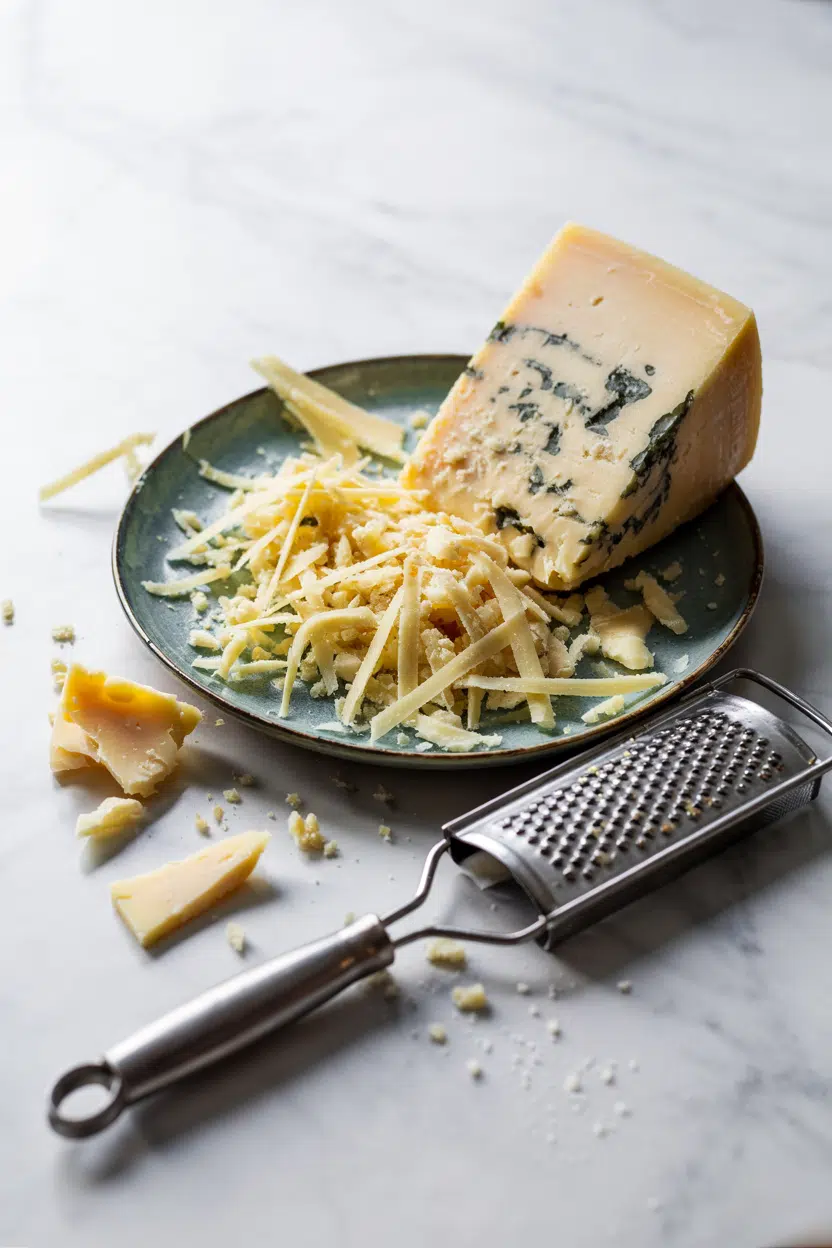
Stilton delivers a sharp, tangy-salty punch upfront, followed by buttery-sweet undertones that soften the initial bite. The finish is distinctly nutty, which sets it apart from more aggressively acidic blues like Roquefort.
Compared to Shropshire Blue, which is a close English relative, Stilton is milder and more dairy-forward - less assertively bitter on the finish. Heat changes things considerably.
Melted Stilton becomes noticeably creamier and the saltiness concentrates, so dishes built around cooked Stilton need less of it than raw applications.
How to Use Stilton Cheese
Stilton works across a wider range of applications than most strong blues because its buttery undertone cushions the sharpness in cooked dishes. Raw uses let the full flavor complexity come through; cooked uses blend it into a background richness.
| Method | Best For | Tip |
|---|---|---|
| 🥗 Raw / Crumbled | Cheese boards, salads with pear and walnuts, celery platters | Crumble by hand - a knife compresses the paste and kills the texture |
| 🍳 Melted into Sauce | Cream sauces for steak, mushroom ragù, pasta | Add off-heat or over very low heat - boiling breaks the emulsion |
| 🫙 Baked | Toast, individual gratin dishes, stuffed mushrooms | Use sparingly; heat amplifies saltiness significantly |
| 🥣 Stirred In | Mashed potatoes, butternut squash soup, dips | Add at the end of cooking to keep flavor bright and clean |
In British cooking, Stilton is traditional on the Christmas cheese board alongside celery and fig jam, and it finds its way into hearty winter soups.
Modern European bistro cooking borrows it for blue-cheese cream sauces on steak.
American steakhouse menus use it in blue cheese dressing - you can build a solid version at home with a creamy garlic mashed potatoes recipe as a base inspiration for getting that rich, tangy texture right.
Strong pairings for Stilton include:
- 🍐 Pear and apple - fresh fruit sweetness cuts the salt cleanly
- 🍷 Port or tawny port - the classic British pairing; sweetness balances the sharpness
- 🌰 Walnuts and toasted hazelnuts - echo the cheese's own nutty finish
- 🍯 Honey or fig jam - bridges the gap between Stilton and milder board elements
- 🍫 Dark chocolate - a small amount works surprisingly well with the earthiness
Stirring Stilton into using butternut squash soup for creaminess adds a tangy depth that the soup's natural sweetness keeps from tipping into overwhelming. Avoid pairing Stilton with delicate floral teas or heavy citrus - both clash with the mold-forward earthiness.
How to Buy and Store Stilton Cheese
At the counter, look for a wedge with firm, cream-to-pale-yellow paste threaded with clear blue-green veins. The natural rind should be dry and slightly flaky - not sticky, not darkly brown, and not carrying an ammonia smell through the packaging.
Once home, wrap Stilton in cheese paper or wax paper - never cling film, which traps moisture and causes the rind to sweat. Keep it in the crisper drawer where temperature is stable.
- 📦 Unopened refrigerated wedge - about 3-4 weeks
- 🧻 Opened and wrapped in cheese paper - 2-3 weeks; rewrap after each use
- 🥣 Crumbled into dishes - use within 2-3 days; the exposed surface degrades fast
Freezing is possible but not recommended - it breaks the crumbly texture and makes the paste grainy when thawed.
Start with a Wedge, Then Scale
If Stilton is new to you, buy a small wedge first and serve it simply: room temperature, with a few oatcakes, a slice of pear, and a drizzle of honey.
That combination shows you everything the cheese can do without cooking getting in the way.
Once you're comfortable with the intensity, move into sauces and soups - that's where Stilton earns its keep on a weeknight.
If a specific dish calls for a blue cheese and you don't have Stilton, look at stilton cheese stand-ins or the broader range of blue cheese swaps that work for guidance on what holds up in cooked applications.
The gap between Stilton and, say, roquefort cheese in dairy recipes is real - Roquefort runs sharper and saltier, so substitutions aren't always one-for-one.
Frequently Asked Questions
Yes. Blue Stilton is a blue-veined cheese made with Penicillium roqueforti cultures, which produce the characteristic blue-green mold channels. White Stilton exists but contains no veining and has a completely different flavor profile.
Strong, but not the most aggressive blue available. It's sharper and saltier than mild blues like Gorgonzola Dolce, however milder and more dairy-forward than Roquefort. Age affects it - older wedges push sharper.
Yes, and it melts well into cream-based sauces. Add it off-heat or over very low heat - boiling causes the fat to split and the sauce to turn grainy. A little goes a long way once melted.
Most commercially sold Stilton in supermarkets uses pasteurized cow's milk. However, some artisan producers still make it from thermized milk. Check the label if pasteurization matters for dietary or medical reasons.
PDO rules restrict production to three English counties: Derbyshire, Leicestershire, and Nottinghamshire. Any cheese called Stilton must be made there - no exceptions. The town of Stilton in Cambridgeshire, despite the name, is not in the protected zone.



