
You spot a bag of limes at the store and grab them for juice - but the real flavor is in the peel. Lime zest, that thin strip of bright green skin scraped free with a microplane, holds the fruit's concentrated aromatic oils in a way juice never does.

Unlike alternatives to lime juice that replicate acidity, zest delivers something different: a clean, floral citrus hit with no liquid, no dilution, and no sourness.
The same logic applies when you look at comparing dried orange zest vs fresh options - freshness determines how much aroma actually makes it onto your food.
Lime zest is the grated outer peel of a lime, packed with citrus oils that deliver bright, slightly floral flavor without juice's acidity. Use it fresh for maximum aroma - it works in everything from marinades to cocktail garnishes, baked goods, and compound butters.
What Is Lime Zest?
Lime zest is the outermost colored layer of the lime peel - specifically the thin green skin of Citrus aurantiifolia - removed with a microplane, box grater, or dedicated zester.
Remember it later
Planning to try this recipe soon? Save it for a quick find later!
It belongs to the broader category of citrus zest, alongside lemon, orange, and grapefruit equivalents.
You'll also see it labeled as grated lime rind, lime peel, lime skin, or simply zest of lime. The name shifts depending on the recipe's origin and whether the piece is grated fine or cut into strips.
Lime cultivation traces back to tropical Southeast Asia and the Americas, and the fruit now grows throughout every tropical and subtropical region. What makes zest distinct from the rest of the peel is what lies just beneath the surface.
- 🟢 The green layer - contains the essential oils, primarily limonene, that produce lime's aroma
- ⚪ The white pith below - spongy, bitter, and worth avoiding entirely when zesting
- 🔬 Limonene content - the dominant compound responsible for lime's sharp, clean citrus scent
- 🌿 Kaffir lime zest - a related but distinct product with a leathery, more complex aroma than standard lime zest
What Does Lime Zest Taste Like?
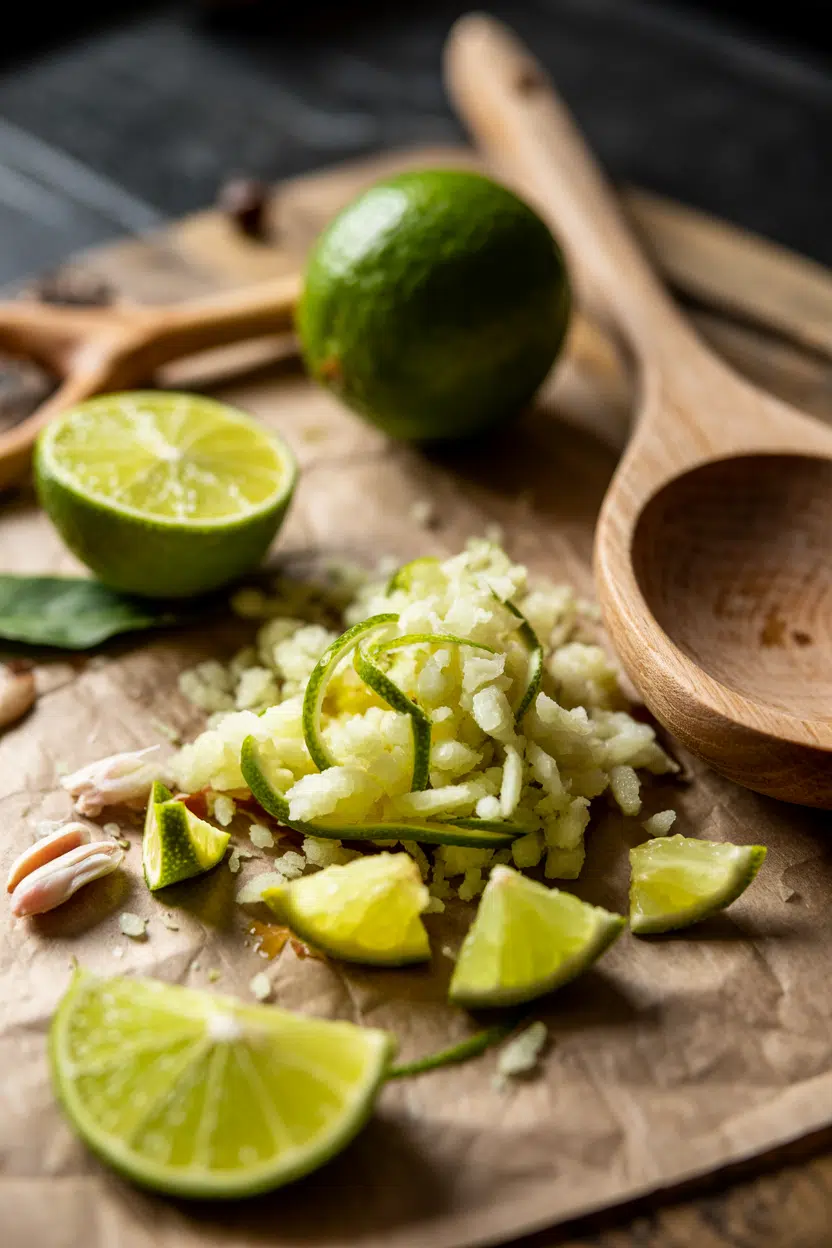
Lime zest tastes citrusy, bright, and slightly floral - closer to the smell of a freshly cut lime than to its juice. There's a faint bitter green note underneath, which is what separates it from the cleaner sweetness of lemon zest.
Compared to lemon zest, lime reads greener and more aromatic, with a floral top-note that lingers. For a full side-by-side on how zest differs from extract, comparing lemon extract vs lemon zest options covers the same principle.
Heat changes the equation fast. Added early in cooking, the volatile oils dissipate and the flavor flattens - sometimes turning mildly bitter.
Added at the finish, those same oils stay bright and forward on the palate.
How to Use Lime Zest
Timing is the core rule: zest added at the end of cooking preserves the aromatic oils. Add it early and you lose most of what makes it worth using.
It works across Mexican, Thai, Vietnamese, and Caribbean cooking - anywhere acidity and freshness matter.
Zest folds into guacamole for a floral top note without extra liquid, and it lifts ceviche without pushing more sourness into the dish.
Making compound lime butter is one of the simplest applications - the same method used for making compound butter (herb) at home works directly with zest as the main aromatic.
Strong pairings include cilantro, fresh chili, coconut milk, ginger, garlic, avocado, fish, shellfish, and rum. One technique worth knowing: blend zest with sugar to make lime sugar, which stores well and adds citrus aroma to cocktail rims, whipped cream, and baked goods.
If you're out and need a swap, the guide on alternatives to lime zest covers what actually works.
| Method | Best For | Tip |
|---|---|---|
| 🥗 Fresh Grating | Garnish on tacos, ceviche, grilled shrimp | Zest directly over the dish so oils land on the food |
| 🍳 Folded In | Batters, doughs, compound butter, dressings | Mix in last so heat doesn't kill the aroma |
| 🧴 Infused | Syrups, oils, lime sugar for cocktails and baking | Use low heat; steep briefly to avoid bitterness |
| 🥩 Marinade | Fish, chicken, shrimp before grilling or roasting | Combine with oil so the oils emulsify and coat evenly |
Avoid using large amounts in long braises - the oils fade and can turn bitter over extended heat.
White chocolate is another awkward pairing in quantity; a small amount is fine, however a heavy hand reads sharp against the cocoa butter.
How to Buy and Store Lime Zest
Choose limes with smooth, bright green skin that feels slightly springy when rubbed. The peel should release a faint citrus smell under light finger pressure - that's the oil content signaling a productive zest.
Store whole limes in the refrigerator crisper in a perforated bag; they'll hold for 2-4 weeks.
Once zested, keep the lime or collected zest in an airtight container - for a full breakdown of how long lime zest keeps under different conditions, refrigerated zest lasts 3-5 days and frozen zest up to 3 months.
Freeze zest in small portions - a teaspoon per cube in an ice tray works well. Thawed zest loses some brightness, however it still performs in cooked applications and baked goods.
Starting with Lime Zest
New to using zest regularly? Start with a finishing move: grate half a lime's worth over your next taco plate or bowl of rice. No recipe required.
From there, kaffir lime leaf swaps that work shows how standard lime zest can stand in when the more aromatic leaf isn't available.
Once you're comfortable with fresh grating, move to infused syrups and lime sugar - both are low-effort ways to build zest's aromatic oils into a format you can use all week.
Frequently Asked Questions
Not exactly. Lime peel includes the white pith underneath the green skin, while lime zest refers only to the thin colored outer layer. The pith is bitter and spongy - zest recipes want only the green part.
Use a microplane and apply light pressure, rotating the lime as you go. Stop as soon as you see white - that's the pith boundary. A few short strokes per section keeps you in the oil-rich green layer.
Yes, in equal amounts. Lime zest reads greener and slightly more floral than lemon zest, so the swap shifts the flavor profile subtly. In most savory dishes and baked goods, the difference is minor.
Freshly grated lime zest keeps 3-5 days in an airtight container in the refrigerator. For longer storage, freeze it - zest holds well for up to 3 months frozen with minimal flavor loss in cooked dishes.
Dried lime zest works in baked goods and spice blends, however the volatile oils that create lime's floral aroma are largely gone. Use about half the amount, and don't expect the same brightness on finished dishes.



