
Potato gratin would be a different dish without béchamel - drier, denser, and missing that creamy binding layer that holds each slice together. This sauce, made from just butter, flour, and milk, shows up across French and Italian kitchens as both a finished product and a starting point for richer derived sauces.
Understanding what béchamel actually tastes like - and how to use it well - is worth the time, whether you're making lasagna or a simple potato gratin.
Béchamel is a mild, silky white sauce built from a butter-flour roux and warm milk. It tastes gently dairy-sweet with a toasty backbone, and it functions as a base sauce, binder, or creamy layer in dozens of dishes. Homemade keeps 2-3 days refrigerated.
What Is Béchamel Sauce?
Béchamel is one of the five classical French mother sauces, which means it functions as the foundation for a family of derived sauces rather than as an end in itself.
Remember it later
Planning to try this recipe soon? Save it for a quick find later!
The base is always a white roux - equal parts butter and flour cooked briefly together - into which warm milk is whisked gradually until the starch hydrates and the sauce thickens.
It originated in seventeenth-century French court cooking and is named after Louis de Béchamel, a financier credited with its development, though the sauce likely predates him.
Outside France, it travels under other names: Italians call it salsa besciamella, and British cooks commonly refer to it as white sauce or sauce blanche.
Variations exist primarily in thickness and seasoning. A thin béchamel pours like heavy cream and works in soups; a thick one holds its shape in croquettes.
Nutmeg is the classic seasoning addition, though white pepper is equally common.
- 🇫🇷 French origin - one of Escoffier's codified five mother sauces
- Core ratio - typically 1:1 butter-to-flour by weight, with milk added to consistency
- Mornay sauce - the most common derivative, made by melting Gruyère or Parmesan into béchamel
- Dietary note - contains gluten and dairy; requires substitutions for vegan or gluten-free diets
What Does Béchamel Sauce Taste Like?
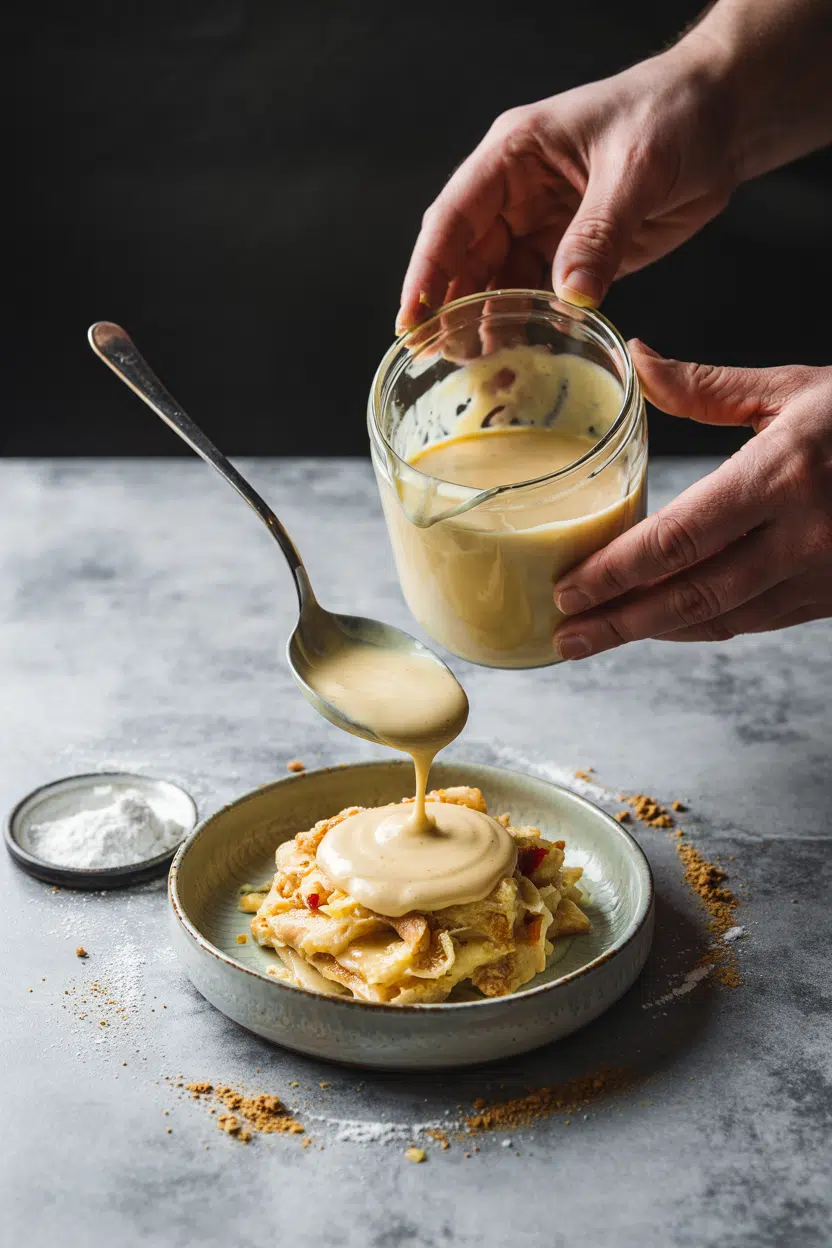
Béchamel on its own is deliberately mild. The dominant note is gentle dairy sweetness from the milk, underscored by the richness of butter.
Behind that is a faint wheaty, toasty quality from the cooked roux - subtle enough that most people don't identify it consciously, but noticeable if the flour is undercooked and raw-tasting.
Seasoning changes everything. A pinch of nutmeg - or a related warm spice; see our allspice vs nutmeg breakdown - adds floral warmth that lifts the sauce from flat to rounded.
Without it, béchamel can taste one-dimensional, more filler than sauce.
Texture matters as much as flavor here. A properly whisked béchamel feels silky and coats ingredients evenly.
Over-thickened, it turns starchy and pasty - closer to a gluey paste than a sauce.
How to Use Béchamel Sauce
Béchamel earns its place in so many recipes because its mild, neutral base absorbs other flavors without fighting them. It carries cheese, mustard, nutmeg, and herbs equally well.
| Method | Best For | Tip |
|---|---|---|
| 🍝 Layered | Lasagna, baked pasta, moussaka | Use medium-thick consistency so it doesn't run between layers |
| 🧀 Cheese base | Mornay sauce, mac and cheese, gratins | Add cheese off-heat to prevent graininess |
| 🥣 Thinned | Cream of mushroom, cream of celery soups | Whisk in stock or extra milk gradually |
| 🫙 Binder | Croquettes, savory soufflés, stuffed vegetables | Use a thick roux ratio so the mixture holds shape when cold |
| 🌿 Enriched | Mustard sauce, horseradish cream sauce | Stir in condiments at the end over low heat |
French cooking treats béchamel as the backbone of the gratin family, and Italian cooks layer it into lasagna alongside ragù to keep the pasta from drying out during long baking. British cuisine reaches for it in fish pies and cauliflower cheese.
American casseroles often use a simplified version made from canned cream soup - that's béchamel in spirit, if not technique.
It pairs naturally with Gruyère, Parmesan, or cheddar for cheese sauces, and with root vegetables like cauliflower, potatoes, and parsnips in baked dishes. Poached or baked white fish also takes well to it.
If you want to compare it to a related hollandaise sauce - another butter-based sauce - the key difference is that béchamel is starch-thickened while hollandaise relies on emulsified egg yolks.
How to Buy and Store Béchamel Sauce
Making béchamel from scratch gives you better texture than any jar. When buying ingredients, select whole milk for its higher fat content - it produces a richer, more stable sauce than reduced-fat versions.
Butter should be pale yellow and firm; unsalted gives you control over the final seasoning.
For storage, the main enemy is skin formation as the sauce cools.
- Press plastic wrap directly onto the sauce surface before refrigerating - this blocks air contact and prevents skin
- Airtight container - keeps for 2-3 days homemade; store-bought refrigerated versions typically last 5-7 days once opened
- Reheat gently - use a low flame and whisk constantly; high heat causes the sauce to scorch or separate
- Freezing works - though texture may turn slightly grainy; whisk vigorously after thawing to re-emulsify
For a full breakdown of timing and signs of spoilage, the bechamel sauce storage life guide covers it in detail.
Where to Start with Béchamel
Start with lasagna if you've never made it before - the sauce gets baked in and minor imperfections in texture disappear. Once that feels easy, move to a stovetop Mornay for mac and cheese, where the sauce is more exposed and technique shows.
If your goal is gratins, a medium-thick béchamel poured over cauliflower and baked until bubbling is low-risk and high-reward. The lasagna storage life article is useful once you start batch-cooking.
Frequently Asked Questions
Yes, in most home-cooking contexts. "White sauce" is the British and American everyday name for béchamel - same roux base, same milk, same technique. The distinction only matters in formal French cooking, where béchamel is specifically one of the five mother sauces.
Pass it through a fine-mesh sieve while still hot, then whisk vigorously. If lumps persist, blend briefly with an immersion blender. The most common cause is adding cold milk too fast - always add warm milk in a slow stream.
Yes, for up to 3 months. Freeze in a sealed container with minimal headspace. Thaw overnight in the fridge, then whisk over low heat - the texture may be slightly grainy but returns to smooth with enough stirring.
Under-seasoning is the usual culprit - béchamel needs salt, white pepper, and nutmeg to taste rounded rather than flat. Using low-fat milk also reduces the dairy richness that gives the sauce its body and faint sweetness.
It works as a binder in croquettes and savory soufflés, a base for creamy soups like cream of mushroom, and a coating sauce for baked fish or vegetable gratins. Thin it with stock for soups; thicken it for croquette filling.



