
Anchovies do something no other ingredient quite replicates: they disappear into a dish and leave pure savory depth behind. A single fillet dissolved in hot olive oil doesn't announce itself - it becomes the foundation.

That invisible contribution is why anchovy paste alternatives fall short and why cooks who swear they hate anchovies often eat them weekly without knowing it.
Anchovies are small cured fish with concentrated umami, salt, and a briny edge. They dissolve into sauces, dressings, and braises to build savory depth. Most recipes use them as seasoning, not protein. Sold as fillets in oil, salt-packed whole, or as paste.
What Is Anchovy?
Anchovies are small, oily fish from the family Engraulidae, with the European species Engraulis encrasicolus dominating Mediterranean and Atlantic fisheries. They're harvested young and almost always preserved - the fresh fish itself is rarely what you encounter at a market.
Remember it later
Planning to try this recipe soon? Save it for a quick find later!
Curing transforms them entirely. Salt-packed anchovies are layered in salt for months until fermentation concentrates their flavor; oil-packed fillets are milder and ready to use straight from the tin. Anchovy paste is simply mashed fillets, typically with salt and oil, pressed into a tube.
Regional names vary widely:
- Anchoa - the Spanish term, often used for high-quality Cantabrian fillets packed in olive oil
- Acciughe - Italian, particularly common in Ligurian and Piedmontese recipes
- Anchoveta - the Peruvian species (Engraulis ringens), fished in massive volumes, mostly processed into fishmeal and oil
European tinned fillets and salt-packed whole anchovies represent the standard cooking varieties. Both deliver intense seasoning - the format you choose depends on how much prep time you have.
What Does Anchovy Taste Like?
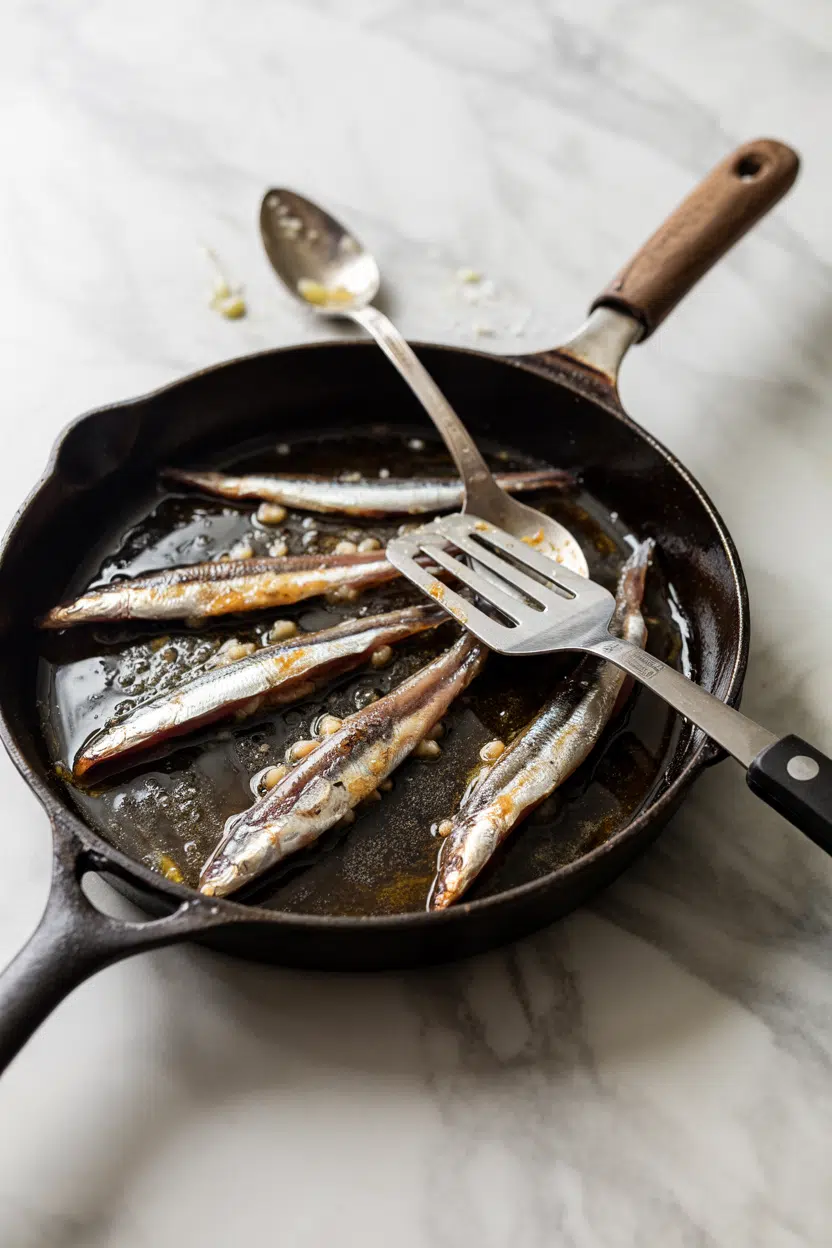
Raw anchovy fillet has a firm, slightly chewy texture and hits you with a direct wave of salt and brine. The fish flavor is real but not overwhelming - closer to concentrated canned fish than to the aggressive fishiness people fear.
Heat changes everything. A fillet dropped into warm olive oil dissolves within two minutes, leaving no visible trace and no pronounced fish flavor - just a deep, savory backbone that reads as richness rather than seafood.
That's the quality that makes anchovy an essential seasoning rather than a topping.
Salt-packed varieties taste cleaner and more complex after rinsing, with less of the oily residue that tinned fillets carry. Fish sauce is a reasonable flavor reference: anchovy delivers that same glutamate intensity but in solid form and with more control over quantity.
How to Use Anchovy
Most cooks use anchovies as a background seasoning, not a featured ingredient. The goal is glutamate delivery - the same reason a splash of fish sauce lifts a stir-fry.
| Method | Best For | Tip |
|---|---|---|
| 🍳 Dissolved in oil | Pasta sauces, braises, flavor bases | Use low heat; high heat scorches and turns bitter |
| 🥗 Chopped raw | Caesar dressing, vinaigrettes, compound butters | Mince finely so texture disappears into the mix |
| 🔥 Baked on top | Pizza, flatbreads, roasted vegetables | Pairs with capers and tomato to balance salt |
| 🫙 Mashed into paste | Tapenades, aioli, bagna càuda, spreads | Salt-packed anchovies give cleaner flavor after rinsing |
Italian cooking uses anchovies most systematically. Pasta puttanesca builds its aggressive, briny sauce on fillets dissolved with garlic and chili - the chicken puttanesca variation follows the same logic with added protein.
Piedmontese bagna càuda goes further, simmering anchovies and garlic in butter until they form a warm dipping sauce for raw vegetables.
French preparations lean toward compound butters and sauces. Spanish Cantabrian anchovies - considered among the finest - are often served simply on bread with olive oil, where the fillet is the focus rather than a background note.
Strong pairings include garlic, capers, tomatoes, lemon, parsley, and red pepper flakes. These ingredients share a sharpness that holds up against anchovy's intensity without being overwhelmed.
How to Buy and Store Anchovy
Oil-packed fillets in tins or glass jars are the easiest starting point. Look for fillets that appear intact, glossy, and uniformly colored - chalky or fragmented fillets suggest age or poor handling. Glass jars let you assess oil clarity before buying; cloudy or dark oil is a flag.
Salt-packed whole anchovies offer cleaner flavor but require rinsing and filleting before use. They're worth the extra step in uncooked applications where the fillet's texture matters.
- Unopened tins - store in a cool, dark pantry; shelf life runs many months to years
- Opened fillets in oil - transfer to a sealed container, keep fillets submerged, refrigerate up to 2-3 months
- Anchovy paste - refrigerate after opening; most tubes last several months once opened
For full detail on anchovy storage life and signs of spoilage, that guide covers both formats in depth.
Start Here
New to anchovies? Start with oil-packed fillets and dissolve one or two into garlic and olive oil before adding pasta or sauce. You won't taste "fish" - you'll taste depth.
From there, try a homemade Caesar dressing to understand how anchovies work in cold applications. If you need a stand-in, anchovy swaps like fish sauce or miso can fill the umami gap, though the texture and salinity differ.
Frequently Asked Questions
Mildly, but far less than most people expect. Cooked into a sauce or dressing, the fish flavor dissolves almost entirely, leaving salt and umami. Salt-packed anchovies rinsed before use taste cleaner than oil-packed straight from the tin.
Very salty - curing in salt is what preserves and flavors them. Most recipes account for this by reducing or eliminating added salt. Rinsing salt-packed anchovies under cold water cuts the intensity noticeably.
Anchovy paste is mashed cured anchovy fillets with salt and oil, sometimes with a small amount of vinegar or spice. It's functionally identical to whole fillets for cooked applications but dissolves faster in cold preparations.
Yes, in reasonable amounts. They're high in long-chain omega-3 fatty acids, protein, vitamin D, and calcium from their small edible bones. Sodium content is significant, so they work better as seasoning than as a primary protein source.
Sardines are milder and less salty, so they won't replicate anchovy's umami intensity in a 1:1 swap. They work as a visual substitute on pizza or toast, but for dissolved seasoning applications, fish sauce is closer. See our guide to sardine alternatives for more options.



